❗This article uses tone or wording inconsistent with the editorial guidelines.
#appeals channel in either Zulip or Discord to request removal.The wiki's voice should remain neutral and avoid loaded language or unnecessary offence. Direct attacks on individuals or companies are not permitted; malice may only be attributed through quotation and citation, never in the wiki's voice. In theme articles argumentation is allowed but should be clear, formal, and never inflammatory.
Apple uses a range of technical measures to protect its App Store ecosystem and reduce consumer choice. These measures obscure the company's business intentions, creating roadblocks for app developers and users, while typically citing security reasons for their existence. This actively hinders lawmakers' ability to advocate for the rights of consumers and businesses within Apple's ecosystem and prevents apps from being as useful as their customers expect.
.svg)
A never-ending demand for a cut of every sale of a digital product, ranging from game currency to supporting content creators[1] to booking a Zoom call with a local business[2], hinders app developers from innovating. These developers, working hard and pulling countless hours to build a quality app, always need to take Apple's (and Google's) demands into account - specifically, a fee of between 15% and 30% of all revenue collected via the app. This is revenue that can be reinvested in the app; however, it must be earmarked for the platforms they are required to use to reach their customers.
Because this is a clear problem, several governments, including South Korea,[3] Japan,[4] the European Union,[5] the United Kingdom,[6] Australia,[7] as well as the US and a handful of states,[8][9][10][11] have opened investigations into anti-competitive practices, or considered or already passed legislation to force "gatekeeper platforms" such as Apple to be more reasonable with third-party developers.
This being a significant threat to Apple's revenue stream (interestingly, one they claim to be unsure is profitable[12][13]), they have responded with practices such as geo-blocking certain operating system functionality based on physical location,[14] misrepresenting/overstating risks, and using careful wording with commonly-understood terms to describe unreasonably difficult-to-use systems.
Unlike traditional software license purchases, Apple's App Store terms tie the license to a specific account, making it impossible for users to resell their licenses secondhand, buy apps secondhand, or inherit a license from a relative.[15] This system has since been copied by numerous other players in the media and digital goods sector.
Background info
Important terms you'll run into in this article:
- Sandbox: Reduces the user's device/data exposure to security risks by reducing what an app is allowed to do.
- Entitlements: Apple's method of "poking holes" in the sandbox to give the app more permissions. Some are available to developers, while many are only available to Apple.
- Digital Markets Act: The European Union's fairly sweeping recent regulations against forcing companies they classify as "gatekeepers" to play nice, giving smaller businesses access to software/hardware features they've historically reserved for their own use.
In-app purchases
Apple has been collecting users' credit card numbers since launching the iTunes Store in 2004. The launch of the App Store in 2008, followed by the introduction of in-app purchases (IAPs) in 2009, allowed iPhone app developers to sell app features to users. The IAP system is provided as a developer framework named StoreKit. Apps and their in-app purchases are managed through a dashboard named App Store Connect. App sales have eclipsed iTunes Store sales, and are now a primary focus of Apple's Media Services division.
Apple requires that any purchase of a digital good or service within an app use its in-app purchase system. This may seem reasonable because the customer may inevitably call Apple support, demanding a refund for an app they have issues with. Apple would rather provide a refund and leave the customer with a positive support experience than initiate a messy process involving contact with a third party, whose customer service is likely to be of a lower quality.
App Store purchase fees range from 15% to 30%. In September 2016, Apple expanded subscriptions to be available for any type of app, also introducing a 15% discount incentive for users who had already subscribed for a year.[16] In November 2020, Apple introduced a reduced 15% fee for app developers with annual revenue below $1 million.[17] For developers above this threshold, and for cases excluded from this program, such as for games, the fee is 30%. In the 2008 announcement of the App Store, Apple considered this a reasonable, industry-standard fee. However, the way we use apps has significantly evolved since 2009 - the world has shifted to heavily depend upon mobile apps, which have also evolved into more complex and sustainable business models than a simple one-time purchase.
Stripe, a popular platform used for payments on the web, uses a base fee of 2.9% plus a fixed $0.30 in the United States.[18] With add-on services, before considering volume discounts, a Stripe transaction may have a cost of 6.4% + $1.10.[19] Stripe has been used by businesses ranging from small online stores to OpenAI for ChatGPT Plus. Competing payment services have similar or identical fees to Stripe. The in-app purchase system does not provide sufficient value to justify the considerably higher costs compared to alternative payment platforms.
The App Store system poorly handles secondary marketplaces of digital services that exist within the primary App Store marketplace, such as Patreon. Apple, however, still requires companies in the business of selling digital services to use this inadequate system. This requires the app to account for Apple's fee, which is significant enough to warrant price increases frequently, and to follow rules even if they do not align with the nature of the service being provided. Apple has often been found in disputes with such apps. This injects extra complication at no benefit to the marketplace, the creator, or the customer - only to Apple, which has little to no involvement after delivering the initial app download to the user's phone. The significant fee also often drives app developers to consider building their app around an advertising model instead, creating privacy concerns.
Additionally, the 15% small business fee discount is determined based on the app's overall turnover and is not applied to individual creators within the app's marketplace. An app that generates over $1 million per year by providing services to creators who individually earn less than $1 million per year does not qualify for the discount.
Apple, often in conjunction with Google, engages in lobbying efforts in the United States and other countries to address these issues. "ACT | The App Association", pitched as an association of independent small business app developers, is at least 50% funded by Apple, and does not list its claimed 2,000 members.[20][21] In March 2024, the United States Department of Justice, along with 16 state attorneys general, filed a lawsuit against Apple, alleging that the company "extracts more money from consumers, developers, content creators, artists, publishers, small businesses, and merchants, among others."[10] The future of this lawsuit is unclear as of April 2025.
Despite criticism of Apple forcing its fee into transactions with small businesses and creators on platforms such as Patreon and Facebook, on January 23, 2025, Apple announced the Advanced Commerce API. It "support[s] developers' evolving business models - such as extensive content catalogs, creator experiences, and subscriptions with optional add-ons".[22] While positioned as a way for such businesses to save development time and avoid ongoing costs by building on top of Apple's mature payments platform, its use is, in fact, necessary for these businesses to comply with the App Store guidelines, as seen in the cases outlined below. The feature requires submitting a description of the app's business model to Apple for approval. This continues a trend of requiring Apple's consent to conduct business in a place where users have been trained to expect it.
Given Apple's strong incentives and a ticking clock as legal pressure builds, it is not hard to find stories from app developers regarding poor experiences with Apple's app review process.
- This list is extremely incomplete. Please add examples if you know of any.
Epic Games
Epic Games, Inc. is a video game developer and publisher, known for games such as Fortnite and Unreal Tournament, the Unreal Engine, and the Epic Games Store.
In 2018, Epic Games launched Fortnite on the iOS and Android platforms. The company made the unusual decision not to release the app on the Google Play Store - instead, it was made available as a standalone Android app package file (.apk), which must be installed by following a series of manual steps.[23] The app was also released on the Samsung Galaxy Store. Google offered Epic Games a $147 million deal to release Fortnite on the Play Store, which the company declined.[24]
On 22 April 2020, Fortnite was finally released on the Play Store.[25] In a statement, the company explained:
After 18 months of operating Fortnite on Android outside of the Google Play Store, we've come to a basic realization: Google puts software downloadable outside of Google Play at a disadvantage, through technical and business measures such as scary, repetitive security pop-ups for downloaded and updated software, restrictive manufacturer and carrier agreements and dealings, Google public relations characterizing third party software sources as malware, and new efforts such as Google Play Protect to outright block software obtained outside the Google Play store.
On 13 August 2020, Epic Games launched a campaign against both Apple and Google's app store business practices. The company released app updates on both platforms, introducing a method for purchasing V-Bucks, in-game currency, at a 20% discount by directly transacting with Epic Games, against the developer rules of both platforms. The platforms responded by removing the game from their storefronts. Epic Games then filed civil antitrust lawsuits against both companies in the Northern District of California.[26] The campaign, branded "Free Fortnite", was later extended with lawsuits and complaints in Australia,[27] the European Union,[28] and the United Kingdom.[29]
On September 11, 2021, Judge Yvonne Gonzalez Rogers decided the case. While the lawsuit against Apple failed on nine of the ten counts, Rogers ruled against Apple's use of "anti-steering" - its strategy of preventing users from being "steered" to a third-party storefront for payment processing - and placed a permanent injunction on this behavior.[30] Despite the case mostly failing, the discovery process provided significant insight into Apple's decision-making process regarding App Store policies, including decisions made in major app review disputes. In one case, executive Phil Schiller argued for reducing the fee by 30%.[31]
Epic Games and Apple both appealed the decision. 35 state attorneys-general, the Electronic Frontier Foundation (EFF), Microsoft, among others, filed amicus briefs in support of Epic Games.[32]
On 11 December 2023, the jury in the case against Google decided on all 11 counts in favor of Epic Games.[33]
On 1 May 2025, Rogers found that Apple willfully chose not to comply with the 2021 injunction, commenting "that it thought this court would tolerate such insubordination was a gross miscalculation".[34]
Facebook online events
In August 2020, in response to the COVID-19 pandemic, Facebook introduced the ability for small businesses to accept an entrance fee for events. Previously, Facebook would only serve as a way to RSVP for the event; the organizer had to use a third-party event ticketing system to collect fees. The company pledged not to collect any fee on event sales "until 2023".[35]
Apple disagreed, requiring the feature to use the in-app purchases system. This introduced Apple's 30% fee. As this increases the price the user pays, with no benefit to the small business the user intended to support, the cost was displayed as a line item in checkout. Apple did not accept this disclosure of the price, referring to it as "irrelevant".[2] Facebook was allowed to compromise on displaying the fee, but without indicating that it is specifically an App Store fee.
HEY
HEY.com is a paid webmail provider launched in June 2020 by long-time software company 37signals, specializing in inbox organization tools.
After successfully launching the initial version of the app on the App Store, the company announced that an update was rejected due to a complaint about the business model. The app does not support in-app purchases; instead, users are expected to have an account with the service already. Apple did not like this arrangement and demanded that the company build an in-app subscription option. The company argued that it is being held to a different set of rules than apps such as Netflix, whose app does not provide any way to purchase a subscription.[36] After a suggestion from Apple executive Phil Schiller in the media, HEY introduced a 14-day free trial mode, which was approved.[37][38]
Patreon
In August 2024, Patreon announced a change in arrangement with Apple for its App Store app. From November 2024, subscriptions started from the iOS app would be required to use the in-app purchase system, bypassing Patreon's own long-standing payment practices.[39][1] This change does not affect the Android app.
By forcing Patreon out of the payments pipeline, specific payment models are no longer available to users of Patreon's iOS app. Creators who rely on the "per-creation" payment model, as opposed to the standard "per-month", can no longer be subscribed to from the app. The app is also unable to support the "first-of-the-month" model, where payments from all subscribers are collected on the first day of the month, rather than every 30 days, since each member's subscription day varies. The price must also be rounded to a price tier supported by Apple.
Patreon allows creators to choose between increasing their prices by 30% in the iOS app or maintaining the same prices, forfeiting 30% to Apple. Creators frequently remind potential supporters not to use the Patreon iOS app, adding extra inconvenience to those wanting to support the work of small creators.
-
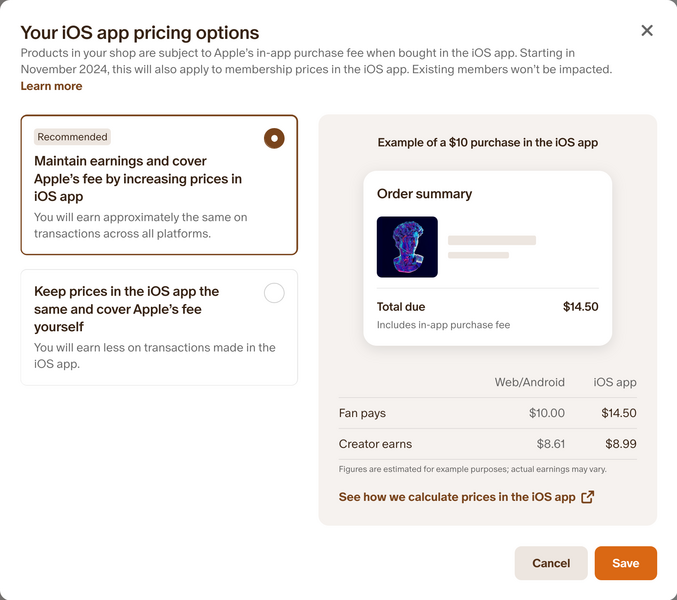 "Maintain earnings and cover Apple's fee by increasing prices in the iOS app" (Recommended)
 -
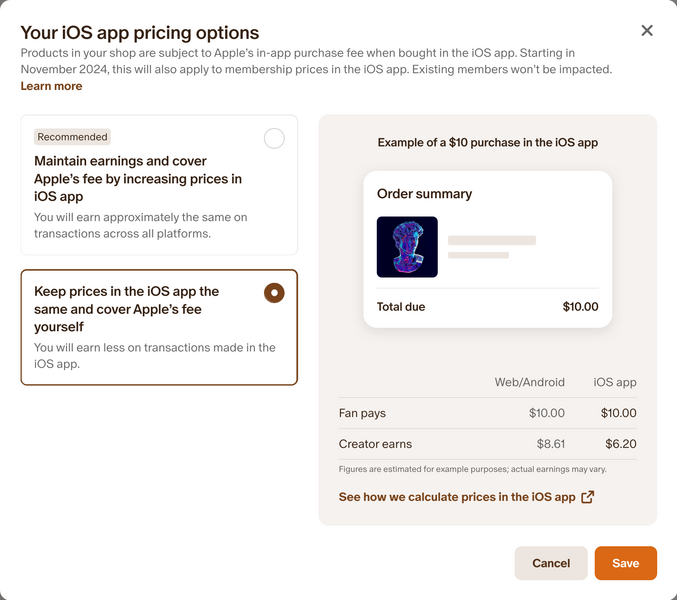 "Keep prices in the iOS app the same and cover Apple's fee yourself."


A similar case occurred with the app Fanhouse in 2021.[40]
In August 2021, Twitter introduced a feature named Super Follows (now Subscriptions), in which users can pay a subscription fee to access more of a creator's content. For each user who enables Subscriptions, Twitter must submit a new in-app purchase SKU to the App Store, which will become available with the next update to the app.[41] This, of course, is subject to the 30% fee. At the time of writing in January 2025, viewing the App Store listing reveals Elon Musk's $4.00 subscription as the fourth most popular IAP item.
Notarization
Since 2015, Apple has required all Mac apps to be "notarized." This is a preliminary, automated malware check, which, upon passing, provides a notary certificate that gets "stapled" to the app. Apple's explanation:
Notarization of macOS software is not App Review. The Apple notary service is an automated system that scans your software for malicious content, checks for code-signing issues, and returns the results to you quickly. If there are no issues, the notary service generates a ticket for you to staple to your software; the notary service also publishes that ticket online where Gatekeeper can find it.[42]
Whether this approach is actually better than that used by Windows antivirus, which only detects new malware samples when they are already on a user's computer, is a separate topic.
To comply with the DMA's regulations on app marketplaces, Apple created a new channel for releasing apps outside of the iOS App Store. Apps go through a notarization process. But the process is definitely not notarization. The name is intentionally being abused, by contrast to notarization on macOS, to make you believe it is something other than the existing App Review system. Despite the pain some developers and users have with it, notarization on macOS has always been considered a net positive. It made sense to take advantage of its reputation for the entirely different "notarization" on iOS.
See for yourself - view the App Review Guidelines and tick "Show Notarization Review Guidelines Only". While this eliminates most rules, a significant number of them remain in place. These apps are still reviewed and tested by the App Review team, must have a complete product listing in App Store Connect, and can be outright rejected - all in the same way as an App Store app.
By contrast, all that is required for notarization on macOS is for your app not to be malware. You submit it to an automated system that approves it within minutes. You don't need to convince Apple that your app is worthy of existing on their platform.
The purpose of macOS notarization is that Apple maintains a record of all binaries intended for wide distribution on macOS, allowing it to review them both in advance and regularly for known malware/common malware patterns. If a malware app manages to get through, when Apple initially finds out, they can go back into the notary records and find every sample of that malware to analyze and block. This is a purely technical process, managed by skilled security researchers. At the same time, iOS app review and "notarization" are business processes managed by workers who have been given a checklist of violations to look for.
Apple is retaining complete control over what's allowed to run on iOS. On macOS, you can choose to run apps that have not been notarized (even though the process to bypass the warning is intentionally difficult). On iOS, you never get even that option. What Apple created is the App Store, but with more steps. It is still available on the App Store, but it is hidden so that it can only be installed through the third-party store it's tied to.
- Mysk: "iOS should enable alternative marketplaces to add their own links when users share their apps. Links still point to the App Store, and if the app is not available there, this happens."[43]
JIT
The following paragraph is highly technical: JIT allows for speedy programs/apps, and due to its fast nature, it's used almost everywhere and represents a massive improvement over older code interpreters.
JIT, which stands for Just-In-Time, is a method of code execution where code, instead of being compiled before being distributed (like an EXE), gets compiled into machine code in real time right before being executed. This method of code execution allows for much faster website loading times, speedier emulation, faster program execution (with programs written in JavaScript, Python, Lua...) compared to interpreters, which instead translate code into machine code line by line, which is much, much slower; JIT also employs many more optimization techniques meant to improve performance.
Safari is allowed to use JIT to compile code from any site, just like Apple's Playgrounds app on iPad. Playgrounds bundle Apple's Swift compiler and share backend code with the version of Playgrounds found in Xcode.
Third-party apps, such as Pythonista (a Python IDE), emulators like Delta and UTM, and terminal environments like iSH, are not allowed to use JIT; instead, they must interpret code, which results in severe performance degradation and increased computational expense, potentially draining more battery.
An example of apps being heavily affected by this restriction is UTM. UTM is a port of QEMU for iOS, iPadOS, and macOS, allowing users to create VMs that can run various operating systems, such as Microsoft Windows. The iPhone's hardware is capable enough to emulate various modern OSes at full speed. Still, due to Apple's JIT limitation, the team behind UTM had to create UTM SE (slow edition), which doesn't require JIT but is nowhere near as fast as UTM with JIT, only being capable of running MS-DOS and derivatives at acceptable speeds. While methods that enable JIT for apps other than Safari and Playgrounds exist (some are currently working on iOS 18.5, like StikDebug), Apple does not allow the use of JIT in notarized apps, meaning that apps that support JIT will have to be sideloaded, which comes with its own set of restrictions.
In the EU, Apple permitted web browsers to use rendering and JavaScript engines other than the built-in with Apple WebKit/JavaScriptCore, with the option for JS engines to use JIT. The browser still needs to be approved by Apple for an entitlement and must then work within the APIs provided by Apple. However, as of January 2025, no browsers using engines different from the built-in ones have been released, primarily due to arbitrarily imposed restrictions intended to discourage the use and development of third-party engines.[44]
However, Apple still does not allow different engines outside of the EU, with or without JIT support.[45]
Sandbox
Sandboxing is a powerful security feature used on all modern platforms, from Windows to iOS, and it's used because most programs need only a few basic permissions. While sandboxing is a great security measure, users may sometimes want to develop or create programs that run outside the sandbox with fewer restrictions. When a program requires additional permissions beyond what the sandbox typically allows, the user is prompted with a permission request, which is particularly useful for basic programs (such as a flashlight app) that need access to sensitive information, like contacts.
As established in previous sections, a program can be granted more access to system features through entitlements. These come in different types:
- Completely safe: Entitlements any developer can opt into, with little to no risk.
- Approval required: Entitlements that might be more of a security risk to allow, e.g., giving considerably wider access to the system, or that Apple simply doesn't want to hand out to just anyone for competitive reasons. The developer must submit a request to Apple, accompanied by evidence of why they require the entitlement.
- Private: Entitlements that are never allowed for any app developer to use. Many of these are reasonably fenced off because they handle user data that is highly sensitive, or bypass permission prompts, and so on, but can also be guarding features that Apple wants to keep private.
There have been exceptions where Apple quietly granted a company access to private entitlements, which has raised eyebrows.
On iOS, you also can't be more secure than the default, strictest sandbox. On macOS, there are several entitlements you must declare to decide whether you're allowed to access certain types of user data at all. Android has used this design from the very start - you can't even perform fundamental tasks, such as accessing the internet, without declaring it in your manifest. It makes it very explicit what the app's intentions are.
iOS has one sandbox used by all App Store apps. System apps and App Store apps developed by Apple are permitted to adjust their sandbox permissions as needed. Third-party apps do not get the right to expand or reduce their sandbox permissions at all. This is clearly less secure. To retake the example of Playgrounds, while it's allowed to run your code from a separate process executing in an ultra-locked-down sandbox with very few permissions, competing apps such as Pythonista must run your code in the same sandbox and address space as the primary app process. The Python interpreter crashing would therefore crash the entire app, possibly losing work. In the worst case, a vulnerability in third-party code could give access to all data stored by/accessible to the app. For example, it would be a nightmare if you accidentally tapped the wrong link in Safari and had a hacker easily steal your cookies from other websites. If that third-party code could run in its own limited sandbox, the risk is significantly reduced.
The only known workaround is to execute the code via JavaScript, as Apple's JavaScriptCore engine runs in a heavily sandboxed process. This requires you to port the code to JavaScript, which may be a lot of work or not viable. You wouldn't want to run the Python interpreter inside JavaScript - the performance would be terrible!
In-app browsers
Safari's in-app browser, which is the minimal version you get when tapping a link from social media, uses an entirely separate data store for each app. The in-app browser isn't aware of cookies in the "full" Safari app, or any other app, and doesn't support Safari extensions. Apple claimed this was to protect users from malicious apps stealing or setting cookies in Safari without their knowledge, which is a fair argument. However, it's hard not to notice that it makes web browsing inconvenient, encouraging users to install native apps where they can make transactions through Apple.[46]
This also means that your browsing history in the in-app browser is lost; there's no history menu, and it is not logged to the history in the full Safari app either. Good luck recalling that article you read a few weeks ago.
See also
- Eligibility
- Posts written by the author of this article:
References
- ↑ 1.0 1.1 Roth, Emma (12 Aug 2024). "Patreon: adding Apple's 30 percent tax is the price of staying in the App Store". The Verge. Retrieved 16 Mar 2025.
{{cite web}}: CS1 maint: url-status (link) - ↑ 2.0 2.1 Paul, Katie; Nellis, Stephen (28 Aug 2020). "Exclusive: Facebook says Apple rejected its attempt to tell users about App Store fees". Reuters. Retrieved 16 Mar 2025.
{{cite web}}: CS1 maint: url-status (link) - ↑ "South Korea approves rules on app store law targeting Apple, Google". Reuters. 8 Mar 2022. Retrieved 16 Mar 2025.
{{cite web}}: CS1 maint: url-status (link) - ↑ Sharwood, Simon (13 Jun 2024). "Japan forces Apple and Google to allow third-party app stores and payments". The Register. Retrieved 16 Mar 2025.
{{cite web}}: CS1 maint: url-status (link) - ↑ Digital Markets Act
- ↑ Competition and Markets Authority (4 Mar 2021). "Investigation into Apple AppStore". gov.uk. Retrieved 16 Mar 2025.
{{cite web}}: CS1 maint: url-status (link) - ↑ "Dominance of Apple and Google's app stores impacting competition and consumers". ACCC. 28 Apr 2021. Retrieved 16 Mar 2025.
{{cite web}}: CS1 maint: url-status (link) - ↑ Open App Markets Act
- ↑ "S.5364 - App Store Accountability Act". congress.gov. 20 Nov 2024. Retrieved 16 Mar 2025.
{{cite web}}: CS1 maint: url-status (link) - ↑ 10.0 10.1 Balsamo, Mike; Liedtke, Mike; Whitehurst, Lindsay; Bajak, Frank (21 Mar 2024). "Justice Department sues Apple, alleging it illegally monopolized the smartphone market". APNews. Retrieved 16 Mar 2025.
{{cite web}}: CS1 maint: url-status (link) - ↑ "It's time to free ourselves from 'Big Tech' monopoly". Arizona Capitol Times. 19 Feb 2021. Retrieved 16 Mar 2025.
{{cite web}}: CS1 maint: url-status (link) - ↑ Lovejoy, Ben (17 Apr 2024). "Schiller doesn't know whether the App Store is profitable; there are no minutes of meetings". 9to5Mac. Retrieved 16 Mar 2025.
{{cite web}}: CS1 maint: url-status (link) - ↑ Lovejoy, Ben (17 Jan 2025). "Apple denies App Store profit margin is 75% – claims to have no clue". 9t05Mac. Retrieved 16 Mar 2025.
{{cite web}}: CS1 maint: url-status (link) - ↑ "Eligibility". The Apple Wiki. Retrieved 16 Mar 2025.
{{cite web}}: CS1 maint: url-status (link) - ↑ "I can sell my apps?". Apple Community. 2014-02-10. Retrieved 2025-11-25.
- ↑ Goode, Lauren (2 Sep 2016). "Apple's new subscription offerings are now available to App Store developers". The Verge. Retrieved 16 Mar 2025.
{{cite web}}: CS1 maint: url-status (link) - ↑ Centers, Josh (18 Nov 2020). "Apple Drops App Store Commission to 15% for Small Developers". TidBITS. Retrieved 16 Mar 2025.
- ↑ "Pricing". Stripe. Retrieved 16 Mar 2025.
{{cite web}}: CS1 maint: url-status (link) - ↑ Calculated from base fee (2.9% + $0.30) + international card (1.5%) + adaptive pricing (2%) + international payment methods ($0.80), as of January 2025
- ↑ "Not a class ACT: the so-called App Association is simply an Apple Association and does NOT represent app developers' interests in fair distribution terms". FOSS Patents. 1 Oct 2021. Retrieved 16 Mar 2025.
{{cite web}}: CS1 maint: url-status (link) - ↑ "Vast majority of ACT | The App Association's funding comes from Apple, former employees tell Bloomberg: astroturfing against app developers' interests". FOSS Patents. 19 Sep 2022. Retrieved 16 Mar 2025.
{{cite web}}: CS1 maint: url-status (link) - ↑ "Introducing the Advanced Commerce API". Apple Developer. 23 Jan 2025. Retrieved 16 Mar 2025.
{{cite web}}: CS1 maint: url-status (link) - ↑ Statt, Nick (3 Aug 2018). "Fortnite for Android will ditch Google Play Store for Epic's website". The Verge. Retrieved 1 May 2025.
{{cite web}}: CS1 maint: url-status (link) - ↑ Robertson, Adi (9 Nov 2023). "Google offered Epic $147 million to launch Fortnite on the Play Store". The Verge. Retrieved 1 May 2025.
{{cite web}}: CS1 maint: url-status (link) - ↑ Carpenter, Nicole (22 April 2020). "Fortnite available on the Google Play Store for the first time". Polygon. Retrieved 1 May 2025.
{{cite web}}: CS1 maint: url-status (link) - ↑ Statt, Nick (14 Aug 2020). "Epic Games is suing Apple". The Verge. Retrieved 1 May 2025.
{{cite web}}: CS1 maint: url-status (link) - ↑ "Epic Games extends its fight against Apple to Australia". Epic Games. 18 Nov 2020. Retrieved 16 Mar 2025.
{{cite web}}: CS1 maint: url-status (link) - ↑ "Epic Game Files EU Antitrust Complaint Against Apple". Epic Games. 17 Feb 2021. Retrieved 16 Mar 2025.
{{cite web}}: CS1 maint: url-status (link) - ↑ "Epic Games files complaint to support CMA Apple investigation". Epic Games. 30 Mar 2021. Retrieved 16 Mar 2025.
{{cite web}}: CS1 maint: url-status (link) - ↑ Brandon, Russell (11 Sep 2021). "Apple must allow other forms of in-app purchase, rules judge in Epic v. Apple". The Verge. Retrieved 1 May 2025.
{{cite web}}: CS1 maint: url-status (link) - ↑ Gurman, Mark (4 May 2021). "Apple's Schiller Floated Cutting App Store Fees a Decade Ago". Bloomberg. Retrieved 1 May 2025.
{{cite web}}: CS1 maint: url-status (link) - ↑ Peters, Jay (29 Jan 2022). "Epic largely lost to Apple, but 35 states are now backing its fight in a higher court". The Verge. Retrieved 1 May 2025.
{{cite web}}: CS1 maint: url-status (link) - ↑ Bensinger, Greg; Scarcella, Mike (13 Dec 2023). "Epic Games wins antitrust case against Google over Play app store". Reuters. Retrieved 1 May 2025.
{{cite web}}: CS1 maint: url-status (link) - ↑ Peters, Jay (1 May 2025). "A judge just blew up Apple's control of the App Store". The Verge. Retrieved 1 May 2025.
{{cite web}}: CS1 maint: url-status (link) - ↑ "Paid Online Events for Small Business Recovery". Meta. 14 Aug 2020. Retrieved 16 Mar 2025.
{{cite web}}: CS1 maint: url-status (link) - ↑ Kastrenakes, Jacob (17 Jun 2020). "Hey.com exec says Apple is acting like 'gangsters,' rejecting App Store updates and demanding cut of sales". The Verge. Retrieved 16 Mar 2025.
{{cite web}}: CS1 maint: url-status (link) - ↑ https://www.hey.com/apple/path/
- ↑ https://techcrunch.com/2020/06/18/interview-apples-schiller-says-position-on-hey-app-is-unchanged-and-no-rules-changes-are-imminent/
- ↑ "Apple's requirements are about to hit creators and fans on Patreon. Here's what you need to know". Patreon. 12 Aug 2024. Retrieved 16 Mar 2025.
{{cite web}}: CS1 maint: url-status (link) - ↑ @jasminericegirl (9 Jun 2021). "#fuckapple, a thread I cofounded @fanhouseapp 8 months ago to empower creators to monetize their content. We pay creators 90% of earnings. Now, Apple is threatening to remove Fanhouse from the app store unless we give them 30% of creator earnings. This is theft and exploitation". X. Retrieved 16 Mar 2025.
- ↑ @wongmjane (2 Sep 2021). "Each Super Follow is an In-App Purchase on the App Store, but because there are too many IAPs for the Twitter app, the App Store only shows 10 instead of the full list". X. Retrieved 16 Mar 2025.
{{cite web}}: CS1 maint: url-status (link) - ↑ "Notarizing macOS software before distribution". Apple Developer. Retrieved 16 Mar 2025.
{{cite web}}: CS1 maint: url-status (link) - ↑ @mysk_co (28 Jun 2024). "iOS should enable alternative marketplaces to add their own links when users share their apps. Links still point to the App Store and if the app is not available there, this happens:". X. Retrieved 16 Mar 2025.
{{cite web}}: CS1 maint: url-status (link) - ↑ "Mozilla says Apple's new browser rules are 'as painful as possible' for Firefox". The Verge. Retrieved 16 Mar 2025.
{{cite web}}: CS1 maint: url-status (link) - ↑ "App Review Guidelines". Apple Developer. Retrieved 16 Mar 2025.
{{cite web}}: CS1 maint: url-status (link) - ↑ @whitehatguy (12 Jun 2017). "Impact of iOS 11 no longer providing shared cookies between Safari, Safari View Controller instances". GitHub. Retrieved 16 Mar 2025.
{{cite web}}: CS1 maint: url-status (link)