
Anti-privacy legislation: Difference between revisions
m added some 4 "citation needed" notices |
No edit summary |
||
| (20 intermediate revisions by 6 users not shown) | |||
| Line 1: | Line 1: | ||
{{Incomplete|issue 1=needs general improvement of quality and quantity of information}} | {{Incomplete|issue 1=needs general improvement of quality and quantity of information}} | ||
[[Anti-privacy legislation]] simply put is legislation that may be created with malicious intent or not that invoke ones right to privacy. In the last decade, governments across the world have introduced various pieces of such legislation, which has caused damage to the privacy consumers have with their technology. | [[Anti-privacy legislation]] simply put is a legislation that may be created with malicious intent or not that invoke ones right to privacy. In the last decade, governments across the world have introduced various pieces of such legislation, which has caused damage to the privacy consumers have with their technology. | ||
==How it works== | ==How it works== | ||
The US legislative process is as follows:<ref name=":0">{{Cite web |title=The Legislative Process |url=https://www.house.gov/the-house-explained/the-legislative-process | | The legislative processes might vary from country or region, but the US legislative process is as follows:<ref name=":0">{{Cite web |date=23 Feb 2026 |title=The Legislative Process |url=https://www.house.gov/the-house-explained/the-legislative-process |url-status=live |archive-url=http://web.archive.org/web/20260119083226/https://www.house.gov/the-house-explained/the-legislative-process |archive-date=19 Jan 2026 |access-date=23 Feb 2026 |website=[[United States House of Representatives]]}}</ref> | ||
#A representative '''needs to sponsor a bill''' | #A representative '''needs to sponsor a bill''' | ||
| Line 14: | Line 14: | ||
Now that such anti-privacy legislation has been approved, it can be enforced by federal agencies via penalties. | Now that such anti-privacy legislation has been approved, it can be enforced by federal agencies via penalties. | ||
Anti-privacy legislations enforce companies, products or services to collect user's sensitive data in order to comply with purposes that are usually tagged as "safety". | |||
==Why it is a problem== | ==Why it is a problem== | ||
Anti-privacy legislations are frequently incompatible with already established legislations or constitutions from countries or regions, that have even been enforced no matter if these legislations are violating the country/region constitution or legislations protecting online privacy, anonymity or freedom of speech. | |||
===Anti-privacy legislation is a direct infringement of the | ===Anti-privacy legislation is a direct infringement of the First and Fourth Amendments found in the Bill of Rights (U.S.A.)=== | ||
*The First amendment states: | |||
*The | <blockquote>Congress shall make no law respecting an establishment of religion, or '''prohibiting''' the free exercise thereof; or '''abridging''' the '''freedom of speech''', or of the press; or the right of the people peaceably to assemble, and to petition the Government for a redress of grievances.<ref>{{Cite web |date=28 Feb 2026 |title=U.S Constitution - First Amendment |url=https://constitution.congress.gov/constitution/amendment-1/ |url-status=live |archive-url=https://web.archive.org/web/20260307171826/https://constitution.congress.gov/constitution/amendment-1/ |archive-date=2026-03-07 |access-date=28 Feb 2026 |website=Constitution Annotated}}</ref></blockquote> | ||
<blockquote>Congress shall make no law respecting an establishment of religion, or '''prohibiting''' the free exercise thereof; or '''abridging''' the '''freedom of speech''', or of the press; or the right of the people peaceably to assemble, and to petition the Government for a redress of grievances.<ref>{{Cite web |title=U.S Constitution - First Amendment |url=https://constitution.congress.gov/constitution/amendment-1/ |access-date=28 Feb 2026 |website=Constitution Annotated}}</ref></blockquote> | |||
If '''Anti-privacy legislation''' were to be implemented, that gives anyone with access to data on someone the ability to '''restrict freedom of speech''' or oppose those with unwanted views of the world, thus infringing the 1st amendment.{{Citation needed|date=28 Feb 2026}} | If '''Anti-privacy legislation''' were to be implemented, that gives anyone with access to data on someone the ability to '''restrict freedom of speech''' or oppose those with unwanted views of the world, thus infringing the 1st amendment.{{Citation needed|date=28 Feb 2026}} | ||
*The | *The Fourth amendment reads as follows: | ||
<blockquote>The right of the people to be secure in their persons, houses, papers, and effects, against '''unreasonable searches and seizures''', shall not be violated, and no Warrants shall issue, but upon probable cause, supported by Oath or affirmation, and particularly describing the place to be searched, and the persons or things to be seized.<ref>{{Cite web |date=28 Feb 2026 |title=U.S Constitution - Fourth Amendment |url=https://constitution.congress.gov/constitution/amendment-4/ |url-status=live |archive-url=https://web.archive.org/web/20260224165919/https://constitution.congress.gov/constitution/amendment-4/ |archive-date=2026-02-24 |access-date=28 Feb 2026 |website=Constitution Annotated}}</ref></blockquote>'''Anti-privacy legislation''' infringes on a citizen's right to avoid "'''unreasonable searches and seizures'''" since it may require/force citizens to show proof of age ('''selfies, IDs, credit cards''') without real probable cause. It may also force said citizen to use less secure services that allow federal agencies to gain higher access to said services and retrieve whatever data is "needed".{{Citation needed|date=28 Feb 2026}} | |||
*'''Anti-privacy legislation''' can also build the framework and foundation for other and more extreme anti-privacy measures, and such anti-privacy measures can lead to the slow development of a '''''surveillance state.'''''<ref>{{Cite web |last=Sherwinter |first=Daniel |date=28 Feb 2026 |title=Surveillance's Slippery Slope; Using Encryption to Recapture Privacy Rights |url=http://www.jthtl.org/content/articles/V5I2/JTHTLv5i2_Sherwinter.PDF |url-status=live |archive-url=https://web.archive.org/web/20240730145810/http://jthtl.org/content/articles/V5I2/JTHTLv5i2_Sherwinter.PDF |archive-date=2024-07-30 |access-date=28 Feb 2026 |website=Journal on Telecommunications and High Technology Law}}</ref> | |||
*'''Anti-privacy legislation''' can also build the framework and foundation for other | |||
==List of Legislation== | ==List of Legislation== | ||
| Line 59: | Line 60: | ||
|[https://leginfo.legislature.ca.gov/faces/billTextClient.xhtml?bill_id=202520260AB1043 California Assembly Bill No. 1043] | |[https://leginfo.legislature.ca.gov/faces/billTextClient.xhtml?bill_id=202520260AB1043 California Assembly Bill No. 1043] | ||
|California, U.S | |California, U.S | ||
|The California Assembly Bill No. "1043" requires operating system owners, publishers/providers, & developers & maintainers to implement system level age verification via an "accessible interface at account setup", which then is used as an "age signal" for "applications available in a covered application store". Any person that violates this proposed bill ( | |The California Assembly Bill No. "1043" requires operating system owners, publishers/providers, & developers & maintainers to implement system level age verification via an "accessible interface at account setup", which then is used as an "age signal" for "applications available in a covered application store". Any person that violates this proposed bill(now law) will face a fine of 2,500$ per unintentional violation or 7,500$ per intentional violation. | ||
|Age Indication | |Age Indication | ||
|Approved (Active Jan 1, 2027) | |Approved (Active Jan 1, 2027) | ||
| Line 67: | Line 68: | ||
|The Colorado Senate Bill "SB26-051" is a "copycat bill" of California's own "Assembly Bill No. 1043" which requires operating systems of any kind(open source or not), to utilize an interface on account setup to gain an age signal for developers to use in the main app store. Overview of said bill reads as follows; "The bill requires application developers to receive user age information and use it to comply with any applicable law." | |The Colorado Senate Bill "SB26-051" is a "copycat bill" of California's own "Assembly Bill No. 1043" which requires operating systems of any kind(open source or not), to utilize an interface on account setup to gain an age signal for developers to use in the main app store. Overview of said bill reads as follows; "The bill requires application developers to receive user age information and use it to comply with any applicable law." | ||
|Device-Based Age Indication | |Device-Based Age Indication | ||
| | |Approved (Active Jan 1, 2028) | ||
|- | |- | ||
|[https://www.congress.gov/bill/119th-congress/senate-bill/737/text S.737 - Screen Act] | |[https://www.congress.gov/bill/119th-congress/senate-bill/737/text S.737 - Screen Act] | ||
|U.S | |U.S | ||
| | |Senate bill S. 737(also known as the '''Screen Act''') is a bill that pushes for Age verification. The Technology Verification measures listed in section 4 state that a covered platform should adopt and utilize age verification measures, and that such measures must ensure that 1; '''users of the covered platform are not minors''' and 2; '''minors are prevented from accessing any content on the covered platform that is harmful to minors.''' | ||
|Age Verification | |Age Verification | ||
|Introduced | |Introduced | ||
| Line 77: | Line 78: | ||
|[https://www.congress.gov/bill/118th-congress/senate-bill/1207 S.1207 - Earn It Act] | |[https://www.congress.gov/bill/118th-congress/senate-bill/1207 S.1207 - Earn It Act] | ||
|U.S | |U.S | ||
| | |The Earn It Act quote "revises the federal framework governing the prevention of online sexual exploitation of children" by limiting the "liability protections of interactive computer service providers(Encryption)", essentially making the Earn it Act an "anti-encryption", which is (for the most part) necessary to protect ones own important documents & maintain a level of privacy in the digital age. | ||
|Anti-Encryption | |Anti-Encryption | ||
|Introduced | |Introduced | ||
|- | |- | ||
|[https://www.congress.gov/bill/119th-congress/senate-bill/1748/text S.1748 - Kids Online Safety Act] | |[https://www.congress.gov/bill/119th-congress/senate-bill/1748/text S.1748 - Kids Online Safety Act] | ||
|U.S | |U.S | ||
| | |The Kids Online Safety Act is one that quote "requires covered online platforms, including social media platforms, to implement tools and safeguards to protect users and visitors under the age of 17. ''Covered platforms'' are online platforms, video games, messaging applications, or video streaming services used or likely to be used by individuals under the age of 17, with specified exceptions." | ||
|Censorship/Age-Gating | |Censorship/Age-Gating | ||
|Introduced | |Introduced | ||
| Line 95: | Line 90: | ||
|[https://www.congress.gov/bill/119th-congress/senate-bill/146 S.146 - TAKE IT DOWN Act] | |[https://www.congress.gov/bill/119th-congress/senate-bill/146 S.146 - TAKE IT DOWN Act] | ||
|U.S | |U.S | ||
| | |The Take It Down Act (stands for '''Tools to Address Known Exploitation by Immobilizing Technological Deepfakes on Websites and Networks Act''') is a law that prohibits the publication of "non-consensual" intimate visual depictions of individuals, both real or '''computer-generated''', and requires certain online platforms to promptly remove such depictions upon receiving notice of their existence.", and such covered platforms are; public websites, online services, or applications that allows for user generated content on forums. Such a law could be and shouldn't be used as an excuse for censorship or otherwise prevention of free speech.<ref>{{Cite web | ||
|last=Kelley | |||
|first=Jason | |||
|title=Congress Passes TAKE IT DOWN Act Despite Major Flaws | |||
|url=https://www.eff.org/deeplinks/2025/04/congress-passes-take-it-down-act-despite-major-flaws | |||
|website=Electronic Frontier Foundation | |||
|date=28 Apr 2026 | |||
|access-date=22 May 2026 | |||
|url-status=live | |||
|archive-url=https://web.archive.org/web/20260501063231/https://www.eff.org/deeplinks/2025/04/congress-passes-take-it-down-act-despite-major-flaws | |||
|archive-date=1 May 2026 | |||
}}</ref> | |||
|Anti-Encryption/Censorship | |Anti-Encryption/Censorship | ||
|Approved | |Approved | ||
|- | |||
|Real-life identity disclosure required to activate SIM cards.<ref>{{Cite web |date=6 Mar 2026 |title=SIM Card Registration |url=https://privacyinternational.org/learn/sim-card-registration |url-status=live |archive-url=https://web.archive.org/web/20251208124027/https://privacyinternational.org/learn/sim-card-registration |archive-date=2025-12-08 |access-date=6 Mar 2026 |website=Privacy International}}</ref><ref>{{Cite web |last=Bischoff |first=Paul |date=2025-04-23 |title=Which governments impose SIM-card registration laws to collect data on their citizens? |url=https://www.comparitech.com/blog/vpn-privacy/sim-card-registration-laws/ |url-status=live |archive-url=https://ghostarchive.org/archive/ShIek |archive-date=2026-01-17 |access-date=6 Mar 2026 |website=Comparitech}}</ref> | |||
|Many countries. | |||
|People are required to associate their real-life identity with their SIM cards, making "burner phones" impossible, and making it impossible to access the cellular Internet without being tracked by the government. Additionally, this can be used to exclude political dissidents from accessing the Internet. | |||
|Identity disclosure | |||
|Approved in many countries over time. | |||
|- | |- | ||
|[https://le.utah.gov/~2026/bills/static/SB0073.html Utah S.B. 73] | |[https://le.utah.gov/~2026/bills/static/SB0073.html Utah S.B. 73] | ||
| Line 440: | Line 452: | ||
|Age Verification | |Age Verification | ||
|Rejected | |Rejected | ||
|- | |||
|[https://legis.la.gov/legis/ViewDocument.aspx?d=1289498 Louisiana HB Bill/Act No. 440] | |||
|Louisiana, U.S | |||
|[TBA] | |||
|Age Verification | |||
|Approve (Active since | |||
|- | |- | ||
|[https://action.freespeechcoalition.com/bill/georgia-hb-910/ Georgia HB 910] | |[https://action.freespeechcoalition.com/bill/georgia-hb-910/ Georgia HB 910] | ||
| Line 476: | Line 494: | ||
|Age Verification | |Age Verification | ||
|Approved (Active since Jul 1 2024) | |Approved (Active since Jul 1 2024) | ||
|- | |||
|[https://www.congress.gov/bill/119th-congress/house-bill/8250/all-info Congress H.R.8250] | |||
|U.S | |||
|[TBA] | |||
|Device-Based Age Verification | |||
|Introduced | |||
|- | |||
|[[Safe Digital Environments Law]] (Ley de Entornos Digitales Seguros) | |||
|Chile | |||
|This project looks to follow practices as the ones that have been taking effect in Europe and Australia, to ban users under 16 from social media. It mandates to add age verification methods to social media sites to prevent underage users to access them | |||
|Age Verification/Censorship | |||
|Introduced | |||
|} | |} | ||
| Line 491: | Line 521: | ||
*[https://www.badinternetbills.com/ Bad Internet Bills] is a website listing quote "bad internet bills" in a easily accessible manner. | *[https://www.badinternetbills.com/ Bad Internet Bills] is a website listing quote "bad internet bills" in a easily accessible manner. | ||
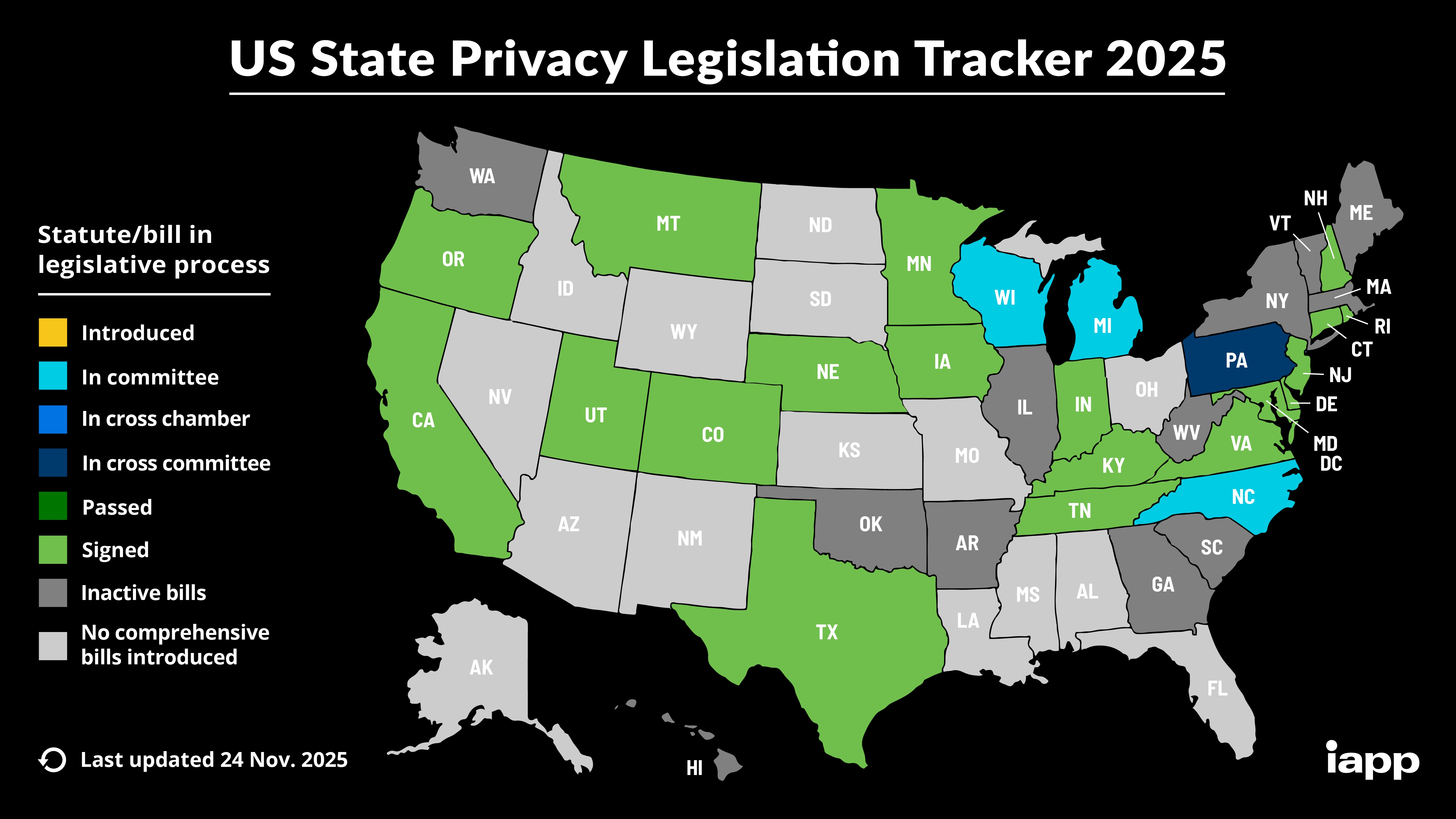
*[https://iapp.org/resources/article/us-state-privacy-legislation-tracker US State Privacy Legislation Tracker] is a sub site of the domain [https://iapp.org/ Iapp] that tracks many but not all pro-privacy or consumer '''U.S''' bills that have passed or not. This includes bills that support consumer rights & bills that businesses are obligated to comply with. (Click [https://assets.contentstack.io/v3/assets/bltd4dd5b2d705252bc/blt76d030a1054f612a/us_state_privacy_legislation_tracker.pdf here] to view the chart & [https://images.contentstack.io/v3/assets/bltd4dd5b2d705252bc/blt8134a824fbb924de/us_state_privacy_legislation_tracker_map.jpg here] to view the map in the '''U.S''') | *[https://iapp.org/resources/article/us-state-privacy-legislation-tracker US State Privacy Legislation Tracker] is a sub site of the domain [https://iapp.org/ Iapp] that tracks many but not all pro-privacy or consumer '''U.S''' bills that have passed or not. This includes bills that support consumer rights & bills that businesses are obligated to comply with. (Click [https://assets.contentstack.io/v3/assets/bltd4dd5b2d705252bc/blt76d030a1054f612a/us_state_privacy_legislation_tracker.pdf here] to view the chart & [https://images.contentstack.io/v3/assets/bltd4dd5b2d705252bc/blt8134a824fbb924de/us_state_privacy_legislation_tracker_map.jpg here] to view the map in the '''U.S''') | ||
==Further Reading== | |||
*[[:Category:Common license terms]] | |||
*[[:Category:Legislation]] | |||
==References== | |||
{{Reflist}} | |||
==External Links== | ==External Links== | ||
*https://action.freespeechcoalition.com/age-verification-bills/ | *https://action.freespeechcoalition.com/age-verification-bills/ | ||
*https://action.freespeechcoalition.com/ | *https://action.freespeechcoalition.com/ | ||
| Line 500: | Line 536: | ||
*https://assets.contentstack.io/v3/assets/bltd4dd5b2d705252bc/blt76d030a1054f612a/us_state_privacy_legislation_tracker.pdf | *https://assets.contentstack.io/v3/assets/bltd4dd5b2d705252bc/blt76d030a1054f612a/us_state_privacy_legislation_tracker.pdf | ||
*https://images.contentstack.io/v3/assets/bltd4dd5b2d705252bc/blt8134a824fbb924de/us_state_privacy_legislation_tracker_map.jpg | *https://images.contentstack.io/v3/assets/bltd4dd5b2d705252bc/blt8134a824fbb924de/us_state_privacy_legislation_tracker_map.jpg | ||
[[Category:Common terms]] | [[Category:Common terms]] | ||
[[Category:Anti-privacy legislation]] | [[Category:Anti-privacy legislation]] | ||
Latest revision as of 05:14, 13 June 2026
⚠️This article has been marked as incomplete. Sourcing or verifiability needs additional work.
#appeals channel in either Zulip or Discord to request removal.Articles must provide verifiable, credible evidence for their claims and avoid relying on forum posts, personal blogs, or other unverifiable sources. You can help by replacing weak citations with reputable reporting, corporate communications, receipts, repair logs, or independent investigative coverage that demonstrates the systemic relevance required by the Mission statement and Moderator Guidelines.
Anti-privacy legislation simply put is a legislation that may be created with malicious intent or not that invoke ones right to privacy. In the last decade, governments across the world have introduced various pieces of such legislation, which has caused damage to the privacy consumers have with their technology.
How it works
[edit | edit source]The legislative processes might vary from country or region, but the US legislative process is as follows:[1]
- A representative needs to sponsor a bill
- The bill is then assigned to a committee for study
- If the bill is released by said committee, the bill is put on a calendar to be voted on.
- If the majority of people vote for the bill(51 or more out of 100), then the bill is passed
- A conference committee made of House & Senate members then works out any differences between the House & Senate version of the bill
- Finally, the resulting bill heads back to the House & Senate for final approval by the President, If the bill is signed, then it has officially become law.[1]
Now that such anti-privacy legislation has been approved, it can be enforced by federal agencies via penalties.
Anti-privacy legislations enforce companies, products or services to collect user's sensitive data in order to comply with purposes that are usually tagged as "safety".
Why it is a problem
[edit | edit source]Anti-privacy legislations are frequently incompatible with already established legislations or constitutions from countries or regions, that have even been enforced no matter if these legislations are violating the country/region constitution or legislations protecting online privacy, anonymity or freedom of speech.
Anti-privacy legislation is a direct infringement of the First and Fourth Amendments found in the Bill of Rights (U.S.A.)
[edit | edit source]- The First amendment states:
Congress shall make no law respecting an establishment of religion, or prohibiting the free exercise thereof; or abridging the freedom of speech, or of the press; or the right of the people peaceably to assemble, and to petition the Government for a redress of grievances.[2]
If Anti-privacy legislation were to be implemented, that gives anyone with access to data on someone the ability to restrict freedom of speech or oppose those with unwanted views of the world, thus infringing the 1st amendment.[citation needed (28 Feb 2026)]
- The Fourth amendment reads as follows:
The right of the people to be secure in their persons, houses, papers, and effects, against unreasonable searches and seizures, shall not be violated, and no Warrants shall issue, but upon probable cause, supported by Oath or affirmation, and particularly describing the place to be searched, and the persons or things to be seized.[3]
Anti-privacy legislation infringes on a citizen's right to avoid "unreasonable searches and seizures" since it may require/force citizens to show proof of age (selfies, IDs, credit cards) without real probable cause. It may also force said citizen to use less secure services that allow federal agencies to gain higher access to said services and retrieve whatever data is "needed".[citation needed (28 Feb 2026)]
- Anti-privacy legislation can also build the framework and foundation for other and more extreme anti-privacy measures, and such anti-privacy measures can lead to the slow development of a surveillance state.[4]
List of Legislation
[edit | edit source]| Bill/Law name | Country/State | Basic summary of Legislation | Method of Eroding Privacy | Status |
|---|---|---|---|---|
| UK Online Safety Act | United Kingdom | The UK Online Safety Act is a set of law's that pushes for Age verification in order to protect quote; "children and adults online". Said enforcement includes disapproving "Illegal Content", & forcing website and domain owners to utilize "highly effective age assurance" to prevent children from accessing potentially harmful content. This act also requires such platforms to " provide parents and children with clear and accessible ways to report problems online when they do arise." | Age Verification | Approved (Signed on Oct 26, 2023, Active since Jul 25 2025) |
| Florida HB 253 | Florida, U.S | Florida's 253 House Bill disallows ones ability to, in their own words, utilize "license plate obscuring devices" to prevent criminals from "escaping from or avoiding detection or arrest in connection with such crime", which could be interpreted as being punished for avoiding ALPR detection. | ALPR Jamming Circumvention | Approved (Signed on May 19th 2025, Active since Oct 1 2025) |
| Texas Senate Bill 2420 (2025) | Texas, U.S | Texas Senate Bill 2420(also known as the "App Store Accountability Act") requires app store owners & maintainers to utilize "Commercially reasonable method('s)" In order to verify the ages their users. If someone is In a category that isn't explicitly labeled "adult", then the user is considered a minor and must ask a parent or legal guardian for permission in order to install new applications that may be considered inappropriate for their age group. | Age Verification | Rejected |
| California Assembly Bill No. 1043 | California, U.S | The California Assembly Bill No. "1043" requires operating system owners, publishers/providers, & developers & maintainers to implement system level age verification via an "accessible interface at account setup", which then is used as an "age signal" for "applications available in a covered application store". Any person that violates this proposed bill(now law) will face a fine of 2,500$ per unintentional violation or 7,500$ per intentional violation. | Age Indication | Approved (Active Jan 1, 2027) |
| Colorado Senate Bill SB26-051 | Colorado, U.S | The Colorado Senate Bill "SB26-051" is a "copycat bill" of California's own "Assembly Bill No. 1043" which requires operating systems of any kind(open source or not), to utilize an interface on account setup to gain an age signal for developers to use in the main app store. Overview of said bill reads as follows; "The bill requires application developers to receive user age information and use it to comply with any applicable law." | Device-Based Age Indication | Approved (Active Jan 1, 2028) |
| S.737 - Screen Act | U.S | Senate bill S. 737(also known as the Screen Act) is a bill that pushes for Age verification. The Technology Verification measures listed in section 4 state that a covered platform should adopt and utilize age verification measures, and that such measures must ensure that 1; users of the covered platform are not minors and 2; minors are prevented from accessing any content on the covered platform that is harmful to minors. | Age Verification | Introduced |
| S.1207 - Earn It Act | U.S | The Earn It Act quote "revises the federal framework governing the prevention of online sexual exploitation of children" by limiting the "liability protections of interactive computer service providers(Encryption)", essentially making the Earn it Act an "anti-encryption", which is (for the most part) necessary to protect ones own important documents & maintain a level of privacy in the digital age. | Anti-Encryption | Introduced |
| S.1748 - Kids Online Safety Act | U.S | The Kids Online Safety Act is one that quote "requires covered online platforms, including social media platforms, to implement tools and safeguards to protect users and visitors under the age of 17. Covered platforms are online platforms, video games, messaging applications, or video streaming services used or likely to be used by individuals under the age of 17, with specified exceptions." | Censorship/Age-Gating | Introduced |
| S.146 - TAKE IT DOWN Act | U.S | The Take It Down Act (stands for Tools to Address Known Exploitation by Immobilizing Technological Deepfakes on Websites and Networks Act) is a law that prohibits the publication of "non-consensual" intimate visual depictions of individuals, both real or computer-generated, and requires certain online platforms to promptly remove such depictions upon receiving notice of their existence.", and such covered platforms are; public websites, online services, or applications that allows for user generated content on forums. Such a law could be and shouldn't be used as an excuse for censorship or otherwise prevention of free speech.[5] | Anti-Encryption/Censorship | Approved |
| Real-life identity disclosure required to activate SIM cards.[6][7] | Many countries. | People are required to associate their real-life identity with their SIM cards, making "burner phones" impossible, and making it impossible to access the cellular Internet without being tracked by the government. Additionally, this can be used to exclude political dissidents from accessing the Internet. | Identity disclosure | Approved in many countries over time. |
| Utah S.B. 73 | Utah, U.S | [TBA] | Age Verification | Passed House committee |
| Ohio HB 84 | Ohio, U.S | [TBA] | Age Verification | Introduced |
| Wisconsin SB 130 | Wisconsin, U.S | [TBA] | Age Verification | Passed Senate |
| Missouri HB 3015/1839 | Missouri, U.S | [TBA] | Age Verification | Passed first committee |
| Iowa HF 2606 | Iowa, U.S | [TBA] | Age Verification | Passed first committee |
| Missouri HB 1839 & 901/1346/1412 | Missouri, U.S | [TBA] | Age Verification | Passed first committee |
| Wyoming HB 72 | Wyoming, U.S | [TBA] | Age Verification | Rejected |
| West Virginia HB 4412 | West Virginia, U.S | [TBA] | Age Verification | Passed the House |
| Rhode Island HB 7746 | Rhode Island, U.S | [TBA] | Age Verification | Introduced |
| Illinois SB 3946 | Illinois, U.S | [TBA] | Age Verification | Introduced |
| Maryland HB 908 | Maryland, U.S | [TBA] | Age Verification | Introduced |
| Tennessee HB 2522/SB 2398 | Tennessee, U.S | [TBA] | Age Verification | Introduced |
| Maryland HB 693 | Mayland, U.S | [TBA] | Age Verification | Introduced |
| Iowa SF 2159 | Iowa, U.S | [TBA] | Age Verification | Introduced |
| West Virginia SB 628 | West Virginia, U.S | [TBA] | Age Verification | Introduced |
| Iowa HF 864 | Iowa, U.S | [TBA] | Age Verification | Passed first chamber |
| West Virginia SB 498 | West virginia, U.S | [TBA] | Age Verification | Introduced |
| New Jersey S 1826 | New Jersey, U.S | [TBA] | Age Verification | Introduced |
| Missouri HB 1878 | Missouri, U.S | [TBA] | Age Verification | Introduced |
| New Hampshire SB 648 | New Hampshire, U.S | [TBA] | Age Verification | Introduced |
| New York S3591 / A3946 | New York, U.S | [TBA] | Age Verification | Introduced |
| Washington HB 2112 | Washington, U.S | [TBA] | Age Verification | Introduced |
| Parents Over Platforms Act - HR 6333 | U.S | [TBA] | Age Verification | Introduced |
| Hawaii HB 1198 | Hawaii, U.S | [TBA] | Age Verification | Introduced |
| Hawaii HB 1212 | Hawaii, U.S | [TBA] | Age Verification | Introduced |
| Iowa SF 207/443 | Iowa | [TBA] | Age Verification | Passed first committee |
| Massachusetts H 1626 | Massachusetts, U.S | [TBA] | Age Verification | Introduced |
| Pennsylvania HB 1513 | Pennsylvania, U.S | [TBA] | Age Verification | Introduced |
| Michigan SB284/HB 4429 | Michigan, U.S | [TBA] | Device-Based Age Verification | Introduced |
| Pennsylvania SB 603 | Pennsylvania, U.S | [TBA] | Age Verification | Introduced |
| Tennessee HB 222 / SB 466 | Tennessee, U.S | [TBA] | Age Verification | Introduced |
| Michigan SB 191 | Michigan, U.S | [TBA] | Age Verification | Introduced |
| Minnesota HF 1875 | Minnesota | [TBA] | Age Verification | Introduced |
| Minnesota SF 2105/HF 1434 | Minnesota, U.S | [TBA] | Age Verification | Introduced |
| Alabama HB 164 | Alabama, U.S | [TBA] | Age Verification | Approved (Active since Oct 1 2024) |
| Alabama HB 393 | Alabama, U.S | [TBA] | Age Verification | Rejected |
| Alabama HB 441 | Alabama, U.S | [TBA] | Age Verification | Rejected |
| Alaska HB 254 | Alaska, U.S | [TBA] | Age Verification | Rejected |
| Arizona HB 2112 | Arizona, U.S | [TBA] | Age Verification | Approved (Signed on May 13th 2025) |
| Arizona HB 2586 | Arizona, U.S | [TBA] | Age Verification | Rejected |
| Arizona HB 2656 | Arizona, U.S | [TBA] | Age Verification | Rejected |
| Arizona SB 1125 | Arizona, U.S | [TBA] (Identical to SB 1298, Arizona) | Age Verification | Rejected |
| Arizona SB 1298 | Arizona, U.S | [TBA] (Identical to SB 1125, Arizona) | Age Verification | Rejected |
| Arizona SB 1341 | Arizona, U.S | [TBA] | Age Verification | Rejected |
| Arizona SB 1503 | Arizona, U.S | [TBA] | Age Verification | Rejected |
| Arkansas SB 66 | Arkansas, U.S | [TBA] (Copycat of Louisiana's AVS law) | Age Verification | Approved (Active since July 31 2023) |
| California AB 127 | California, U.S | [TBA] | Age Verification | Approved |
| California AB 1501 | California, U.S | [TBA] | Age Verification | Rejected |
| California AB 2273 (2022) | California, U.S | [TBA] | Age Verification/Censorship | Approved |
| California AB 3080 | California, U.S | [TBA] | Age Verification | Rejected |
| CASE–IT Act (2023) | U.S | [TBA] | Age Verification/Censorship | Rejected |
| Colorado SB 25-201 | Colorado, U.S | [TBA] | Age Verification | Rejected |
| Delaware HB 265 | Delaware, U.S | [TBA] | Age Verification | Rejected |
| Florida HB 3 | Florida, U.S | [TBA] | Age Verification | Approved (Active since Jan 1 2025) |
| Florida HB 931/SB 1438 | Florida, U.S | [TBA] | Age Verification | Rejected |
| Florida SB 1620 | Florida, U.S | [TBA] | Age Verification/Censorship | Rejected |
| Florida SB 472 | Florida, U.S | [TBA] (Copycat of Louisiana's AVS law) | Age Verification | Rejected |
| Louisiana HB Bill/Act No. 440 | Louisiana, U.S | [TBA] | Age Verification | Approve (Active since |
| Georgia HB 910 | Georgia, U.S | [TBA] | Age Verification | Failed (Incorporated in SB 351) |
| Georgia SB 351 | Georgia, U.S | [TBA] | Age Verification | Approved (Active since Jul 1 2025) |
| Hawaii HB 1198 | Hawaii, U.S | [TBA] | Age Verification | Introduced |
| Hawaii HB 1212 | Hawaii, U.S | [TBA] | Age Verification | Introduced |
| Idaho H 448 | Idaho, U.S | [TBA] | Age Verification | Rejected |
| Idaho H 498 | Idaho, U.S | [TBA] | Age Verification | Approved (Active since Jul 1 2024) |
| Congress H.R.8250 | U.S | [TBA] | Device-Based Age Verification | Introduced |
| Safe Digital Environments Law (Ley de Entornos Digitales Seguros) | Chile | This project looks to follow practices as the ones that have been taking effect in Europe and Australia, to ban users under 16 from social media. It mandates to add age verification methods to social media sites to prevent underage users to access them | Age Verification/Censorship | Introduced |
What you can do
[edit | edit source]In order to oppose/dispute Anti-privacy legislation created by legislators, you can:
- Spread the word; not everyone knows about these bills or the mere existence of these types of bills and therefore wont even fight back[citation needed (1 Mar 2026)]
- Contact local legislators & representatives; If enough people oppose a proposed bill, local legislators may delay the bill or back off on their decision entirely. If enough citizens instead urge a representative to vote against a bill, said representatives could potentially follow up on the citizen's behalf.[citation needed (1 Mar 2026)]
- Sign Petitions; Signing petitions is another way to the message across to both legislators & other people alike.[citation needed (1 Mar 2026)]
- Support Pro Consumer/Privacy Bills; Supporting bills/would-be laws that protect consumer privacy & ownership helps circumvent future bills that aims for the opposite affect.[citation needed (1 Mar 2026)]
Tools & Resources
[edit | edit source]- Age Verification Bills is a sub-site of the the domain Action Free Speech Coalition that specifically lists all bills pushing for any form of "Age verification".
- Bad Internet Bills is a website listing quote "bad internet bills" in a easily accessible manner.
- US State Privacy Legislation Tracker is a sub site of the domain Iapp that tracks many but not all pro-privacy or consumer U.S bills that have passed or not. This includes bills that support consumer rights & bills that businesses are obligated to comply with. (Click here to view the chart & here to view the map in the U.S)
Further Reading
[edit | edit source]References
[edit | edit source]- ↑ 1.0 1.1 "The Legislative Process". United States House of Representatives. 23 Feb 2026. Archived from the original on 19 Jan 2026. Retrieved 23 Feb 2026.
- ↑ "U.S Constitution - First Amendment". Constitution Annotated. 28 Feb 2026. Archived from the original on 2026-03-07. Retrieved 28 Feb 2026.
- ↑ "U.S Constitution - Fourth Amendment". Constitution Annotated. 28 Feb 2026. Archived from the original on 2026-02-24. Retrieved 28 Feb 2026.
- ↑ Sherwinter, Daniel (28 Feb 2026). "Surveillance's Slippery Slope; Using Encryption to Recapture Privacy Rights" (PDF). Journal on Telecommunications and High Technology Law. Archived (PDF) from the original on 2024-07-30. Retrieved 28 Feb 2026.
- ↑ Kelley, Jason (28 Apr 2026). "Congress Passes TAKE IT DOWN Act Despite Major Flaws". Electronic Frontier Foundation. Archived from the original on 1 May 2026. Retrieved 22 May 2026.
- ↑ "SIM Card Registration". Privacy International. 6 Mar 2026. Archived from the original on 2025-12-08. Retrieved 6 Mar 2026.
- ↑ Bischoff, Paul (2025-04-23). "Which governments impose SIM-card registration laws to collect data on their citizens?". Comparitech. Archived from the original on 2026-01-17. Retrieved 6 Mar 2026.
External Links
[edit | edit source]- https://action.freespeechcoalition.com/age-verification-bills/
- https://action.freespeechcoalition.com/
- https://www.badinternetbills.com/
- https://iapp.org/resources/article/us-state-privacy-legislation-tracker
- https://assets.contentstack.io/v3/assets/bltd4dd5b2d705252bc/blt76d030a1054f612a/us_state_privacy_legislation_tracker.pdf
- https://images.contentstack.io/v3/assets/bltd4dd5b2d705252bc/blt8134a824fbb924de/us_state_privacy_legislation_tracker_map.jpg