While the battery remains a standard CR2032 coin battery, and the mounting mechanism is not completely inaccessible, due to this misleading language in the manual and obfuscated location of the battery, it is a blatant attempt to make the mainboard obsolete when the battery dies. Replacement requires service from an experienced technician, leading to more device turnover. For 40 years of mainboard design, replacing a CMOS battery has required locating the battery on the face of the mainboard, pressing a clearly marked tab and removing the old battery out of the standardized component clip slot, and putting a replacement one in its place. There is no reason to have changed this.
While the battery remains a standard CR2032 coin battery, and the mounting mechanism is not completely inaccessible, due to this misleading language in the manual and obfuscated location of the battery, it is a blatant attempt to make the mainboard obsolete when the battery dies. Replacement requires service from an experienced technician, leading to more device turnover. For 40 years of mainboard design, replacing a CMOS battery has required locating the battery on the face of the mainboard, pressing a clearly marked tab and removing the old battery out of the standardized component clip slot, and putting a replacement one in its place. There is no reason to have changed this.
The operating temperature of a CR coin cell is typically -30°C to 85°C, it's recommended to consult the manufacturer should the temperature exceeds 70°C<ref>{{Cite web |date=2024-07-01 |title=CR2032 CR Coin-type Lithium Battery |url=https://energy.panasonic.com/dam/master/pdf/en/datasheet/lithium/CR2032_Datasheet_EN_240701.pdf |url-status=live |archive-url=https://web.archivep75mbjunhxc6x4j5mwjmomyxb573v42baldlqu56ruil2oiad.onion/web/20260302101209/https://energy.panasonic.com/dam/master/pdf/en/datasheet/lithium/CR2032_Datasheet_EN_240701.pdf |archive-date=2026-03-02 |access-date=2026-03-02 |website=Panasonic Energy}}</ref>. VRM runs at a higher temperature typically around 80°C to 90°C, with safe operating temperature exceeds 100°C<ref>{{Cite web |last=u/jayyywhattt |date=2022-01-07 |title=Motherboard, vrm temperatures |url=https://old.reddit.com/r/overclocking/comments/ry9cdc/motherboard_vrm_temperatures/ |url-status=live |archive-url=https://web.archivep75mbjunhxc6x4j5mwjmomyxb573v42baldlqu56ruil2oiad.onion/web/20260302101503/https://old.reddit.com/r/overclocking/comments/ry9cdc/motherboard_vrm_temperatures/ |archive-date=2026-03-02 |access-date=2026-03-02 |website=[[Reddit]]}}</ref>. Mounting the CMOS battery at or very close to the VRM heatsink can reduce the battery life.
The operating temperature of a CR coin cell is typically -30°C to 85°C, it's recommended to consult the manufacturer should the temperature exceeds 70°C<ref>{{Cite web |date=2024-07-01 |title=CR2032 CR Coin-type Lithium Battery |url=https://energy.panasonic.com/dam/master/pdf/en/datasheet/lithium/CR2032_Datasheet_EN_240701.pdf |url-status=live |archive-url=https://web.archivep75mbjunhxc6x4j5mwjmomyxb573v42baldlqu56ruil2oiad.onion/web/20260302101209/https://energy.panasonic.com/dam/master/pdf/en/datasheet/lithium/CR2032_Datasheet_EN_240701.pdf |archive-date=2026-03-02 |access-date=2026-03-02 |website=Panasonic Energy}}</ref>. VRMs typically run at higher temperatures typically around 80°C to 90°C, with safe operating temperature exceeding 100°C<ref>{{Cite web |last=u/jayyywhattt |date=2022-01-07 |title=Motherboard, vrm temperatures |url=https://old.reddit.com/r/overclocking/comments/ry9cdc/motherboard_vrm_temperatures/ |url-status=live |archive-url=https://web.archivep75mbjunhxc6x4j5mwjmomyxb573v42baldlqu56ruil2oiad.onion/web/20260302101503/https://old.reddit.com/r/overclocking/comments/ry9cdc/motherboard_vrm_temperatures/ |archive-date=2026-03-02 |access-date=2026-03-02 |website=[[Reddit]]}}</ref>. Mounting the CMOS battery at or very close to the VRM heatsink can reduce the battery life.
==Workarounds==
==Workarounds==
Revision as of 10:33, 2 March 2026
🧽🫧This article needs cleanup. It contains sources and content but lacks proper formatting/structure.
More info ▼
Common issues include not following the correct preload outline (incident, company, product), references that don't use <ref></ref> or Cite web, leftover "WIP" markers, or long quotes not wrapped in Quote. You can help by applying the relevant preload sections, converting raw URLs into proper citations, and removing editor notes.
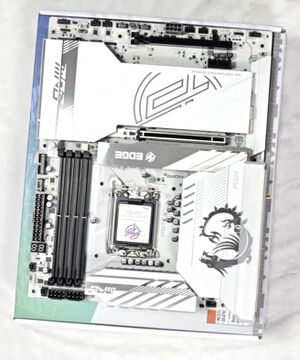
MSI Mainboard CMOS CR2032 batteries are no longer contained within a standard easily accessible clip-mount holder. Instead the CMOS battery is hidden beneath the Voltage Regulator Module (VRM) heatsink assembly, and is affixed to the mainboard via a lead, and mounted with adhesives and shrink-wrap plastic.[1][2] Some of the lower-end tier models of MSI motherboard still have a clip-mount, but it is blocked by heatsinks (that are not part of the VRM assembly). All current models (2025-2026) of motherboard have a line of text in the user manual that states the following:
● This product contains an irreplaceable battery.[3]
This is False. The battery is a standard CR2032 battery. It is not rechargeable, or unique, and is replaceable, with some extended effort.
While the battery remains a standard CR2032 coin battery, and the mounting mechanism is not completely inaccessible, due to this misleading language in the manual and obfuscated location of the battery, it is a blatant attempt to make the mainboard obsolete when the battery dies. Replacement requires service from an experienced technician, leading to more device turnover. For 40 years of mainboard design, replacing a CMOS battery has required locating the battery on the face of the mainboard, pressing a clearly marked tab and removing the old battery out of the standardized component clip slot, and putting a replacement one in its place. There is no reason to have changed this.
The operating temperature of a CR coin cell is typically -30°C to 85°C, it's recommended to consult the manufacturer should the temperature exceeds 70°C[4]. VRMs typically run at higher temperatures typically around 80°C to 90°C, with safe operating temperature exceeding 100°C[5]. Mounting the CMOS battery at or very close to the VRM heatsink can reduce the battery life.
Workarounds
If your CMOS battery dies and needs replacing, here are some steps to follow to replace your 'irreplaceable' battery.
CMOS Battery LocationMSI Z890 Edge TI Wifi Mainboard with VRM heatsink removed and CMOS battery highlighted
Obtain a new standard CR2032 battery.
Un-mount your mainboard from your computer case and look for several screws on the reverse side of the board opposing the VRM assembly. Removing these allows you to remove the VRM heatsink.
Be mindful of the exposed thermal pads, and keep them clean while performing this process. Cover exposed pads with plastic wrap if your work environment is not clean.
If your model contains an RGB lighting assembly on the VRM heatsink watch for the cable that is attached to the mainboard to enable this. Carefully unplug that cable if present.
Locate the CMOS battery and unplug the leads. The leads should be a pair of black and red wires leading to a miniature mainboard plug. Unplug the connector.
Dismantle the wrapping on the battery unit itself and un-mount the leads from the battery surface by either force, desoldering, or clipping them.
The same mainboard with VRM heatsink installedSolder each lead to a piece of nickle strip, and use a tackwelder to re-anchor each strip to the correct polarity battery surface. Alternatively, simply wrap some electricians tape to re-anchor leads to the terminals, though be mindful, that tape adhesive will weaken over time, leading to possible loose connections. Tack welding is preferable. Upon completing this assembly to your satisfaction, move on to the next step.
Encase the new battery with electrical tape and re-mount it near the original location. Standard double sided foam tape should function nicely for this. Hotglue also works.
Replace the VRM heatsink, ensuring good contact across all thermal pads, and reconnecting the RGB lighting connector if it is present.
Re-Anchor the screws on the opposing side of the PCB.
Congratulations! Your CMOS battery has now been changed.
Products
MSI MEG & MPG Motherboards 2025-2026(Current)
MSI MAG Motherboards (2025-2026) still have standard clip-holder mounts for their batteries. (Though the manual still reads "This product contains an irreplaceable battery").