User:Louis/3D printer firearm-blocking mandates and geometric false positives
New York's 3D printer blocking technology mandate, enacted in May 2026, would require a printer sold in the state to refuse a print job until the file has been evaluated by a firearms blueprint detection algorithm and found not to produce a firearm or illegal firearm part. That requirement is not yet in force: it takes effect one year after rules are promulgated under section 837-aa, no rules exist as of June 2026, and a state working group must first report on feasibility. If the working group determines the technology is not technologically feasible, no regulations are required to be promulgated.[1] The statute defines that algorithm as a software service that reads a printing file "whether in the form of stereolithography (STL) files or other computer aided design files or geometric code," and directs the state to supply it with a library of blueprint files "including scans of seized firearms."[1][2]
A file in any of those forms is a description of geometry. An STL mesh is a list of vertices and the triangles drawn between them; a computer-aided-design file is a set of solids and the operations that build them; G-code is a sequence of coordinates the print head moves through. None of those formats carries a field that records what the object is for. A program reading them sees coordinates, volumes, bores, threads, wall thicknesses, and tolerances, and nothing else. It has no concept of a gun. Phillip Torrone of the open-source hardware company Adafruit, whose analysis Techdirt reproduced, framed the task as a classification problem: a detection system would have to recognize every firearm component from raw geometry without flagging the pipes, tubes, blocks, brackets, and gears that share the same shapes, and he argued it would carry high false-positive and false-negative rates.[3] The Electronic Frontier Foundation called the requirement "an unfeasible tech solution."[4]
The reason sits in the geometry. A restricted firearm component is, to the scanner, a signature: some combination of primitive shapes and dimensions. Any benign object that carries the same signature is flagged with it. Tighten the signature to spare the benign twin and a builder defeats it with an edit smaller than the eye can see, or by splitting the part into pieces that each resemble nothing in particular. Either the false-positive rate is high enough to flag everyday hardware, or the false-negative rate is high enough to make the mandate a formality. The companion essay on the technical basis for printer mandates develops the other half of that objection, that a consumer printer makes only the low-stress frame while the pressure-bearing metal parts are bought unregulated. What follows is the geometric half.
How a geometry scanner reads a print file
There are three plausible ways to build the detection the statute describes, matching the three file forms it names. Each fails in a different way.
Pre-slice file hashing and mesh feature matching
The simplest filter computes a digital fingerprint of an STL or 3MF file and compares it against a list of known firearm files, or matches mesh features against a stored template. An STL file is only a list of coordinates for the triangles that tile an object's surface. Moving a single vertex by a thousandth of a millimeter, or remeshing the surface so it carries one fewer triangle, rewrites the file and changes its fingerprint while leaving the printed object identical to the hand and to a set of calipers. A library of fingerprints, the form the statute's directive to store "scans of seized firearms" most often takes, matches only the files it has already recorded, byte for byte.[2] Feature matching against a template is harder to evade than a raw fingerprint, but it reduces to measuring a shape against a reference, which returns to the central problem: the reference shapes are shared with benign parts.
Post-slice G-code and layer analysis
Because file fingerprinting is brittle, a scanner could instead read the G-code the slicer produces. G-code is not a model; it is a list of motor moves, the tool path the print head follows layer by layer. The same receiver yields different G-code when it is rotated on the build plate, sliced at a different layer height, or filled with a different infill pattern. Recovering the three-dimensional object from the tool path means simulating the whole print. The file a printer executes describes paths, not labeled parts. Torrone added that the bill could be improved by exempting open-source firmware, and many printers run offline or on firmware no state library reaches.[3] A part printed face-down in an unusual orientation presents the scanner with an unfamiliar tool path.
Machine-learning voxel and point-cloud classifiers
The most capable approach trains a model on the volumetric shape, the voxels, or on the surface points of an object. A trained classifier does not know what a firearm is; it has learned that certain clusters of coordinates correlate with the examples labeled as guns. A benign part with the same shape satisfies the same correlation. Push the decision boundary wide enough to catch a lightly edited firearm component and it sweeps in the brackets and tubes that sit near it in shape space; pull it in to spare them and a small edit moves the firearm part across the line. Torrone described exactly this trade between false positives and false negatives.[3]
The pairs below are the concrete form of that trade. Each is a restricted firearm component beside a benign object that occupies the same region of shape space. Where a freely licensed image of both objects exists, they are shown side by side.
Restricted components and their benign geometric twins
Suppressor baffle and Tesla valve
-
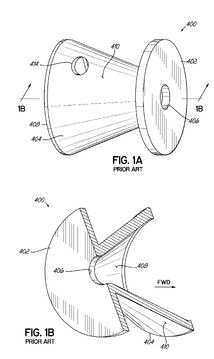 Figures 1A and 1B of US Patent 7,987,944, a firearm sound suppressor baffle: a conical bell with a central aperture and a rear plate.
 -
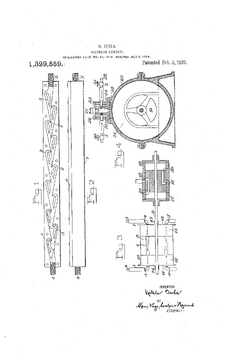 Drawings from Nikola Tesla's US Patent 1,329,559, Valvular Conduit (patented February 3, 1920): a one-way fluid conduit that uses internal cones and baffles to resist reverse flow.


A sound suppressor slows the gas leaving a muzzle by passing it through a stack of internal baffles. The K-baffle, named for the shape its cone and spacer trace in cross-section, is drawn in US Patent 7,987,944 for a firearm sound suppressor baffle as a conical bell with a central aperture set in a rear plate.[5] Its job is to make a gas stream turn and collide with itself.
Making a fluid turn and collide with itself, with no moving parts, is the entire function of a valvular conduit, the one-way passage Nikola Tesla patented in 1920 as US Patent 1,329,559. Tesla's drawings show a run of internal cones and buckets that let fluid pass easily one way and resist it the other.[6] A single segment of that conduit and a suppressor baffle are the same primitives: an outer cylinder, an internal conical frustum, a central bore, and ports for cross-flow. A scanner that flags a hollow cylinder holding internal cones around a central aperture flags both the silencer baffle and the fluid valve.
The edit that defeats it is a thin solid membrane sealing the central aperture in the file. To the classifier the part is then a closed cup, not a baffle with a bore. After printing, the membrane is pushed out with a screwdriver.
Pistol conversion device and camera accessory shoe
-
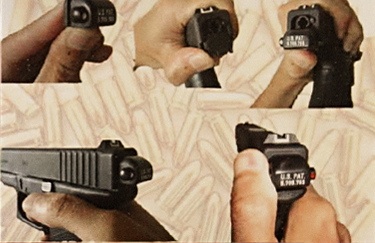 Glock-pattern pistols fitted with a rear backplate auto-sear conversion device, commonly called a Glock switch. An ATF image.
 -
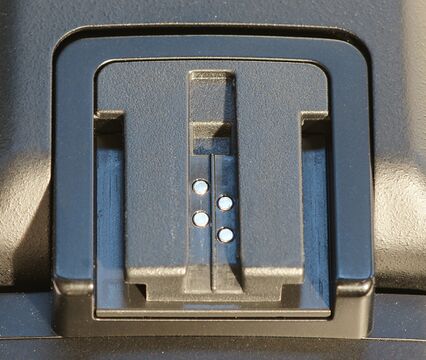 A camera flash and accessory shoe, showing the rectangular dovetail-rail mount with center contacts.


A pistol conversion device, commonly called a Glock switch, replaces the rear backplate of a Glock-pattern pistol and holds the trigger bar so the pistol fires automatically. Title 26 of the U.S. Code defines a machinegun at 26 U.S.C. § 5845(b) to include:
any part designed and intended solely and exclusively, or combination of parts designed and intended, for use in converting a weapon into a machinegun.
Geometrically the device is a small rectangular block with a dovetail rail on one face, which slides into the rear channel of the slide, and a central pin or cam.
A camera accessory shoe, the mount that holds a flash on top of a camera, is a small rectangular block with a dovetail rail and a center contact. To a bounding-box or point-cloud classifier, a dovetailed block a centimeter or two on a side is a dovetailed block a centimeter or two on a side. The defeat is a slight rescale, inside the shrinkage tolerance of fused-deposition printing, or a superficial fin added to the outside face that changes the bounding volume without touching the rail that does the work.
Suppressor outer tube and flashlight body
-
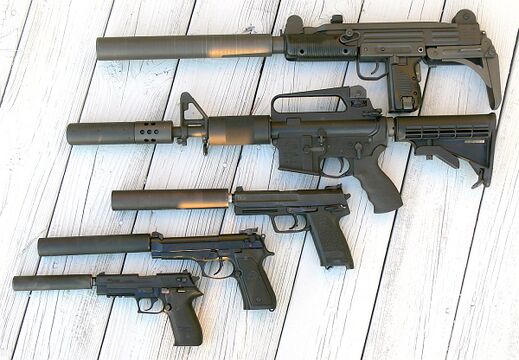 Sound suppressors, the cylindrical tubes at left, mounted on several firearms. The outer body of a suppressor is a hollow threaded cylinder.
 -
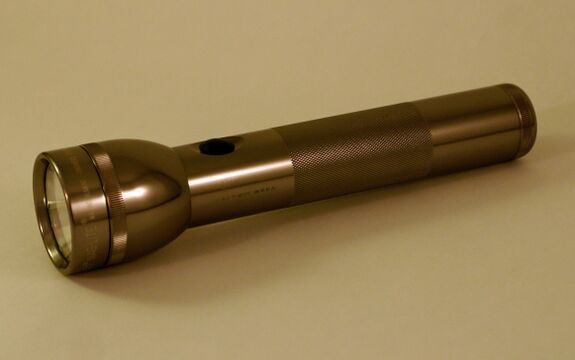 An aluminum flashlight with a knurled, threaded tubular body and a threaded bezel and tailcap.


The outer body of a suppressor is a hollow cylinder, threaded at one end to mount on a barrel and often at the other for an end cap, enclosing the baffle stack.[5] A heavy aluminum flashlight body is a hollow cylinder, threaded at one end for the head and at the other for the tail cap, enclosing a stack of batteries. Both are two concentric cylinders with helical threads cut at the ends. A telescoping camera pole, a vacuum wand, and a plumbing adapter are the same. A scanner that flags threaded tubes of suppressor diameter flags the flashlight, the pole, and the adapter. The defeat is to split the tube into two shorter unthreaded cylinders joined by a slip fit, so no single file is a threaded tube of the flagged length.
AR-15 lower receiver and electronics enclosure
-
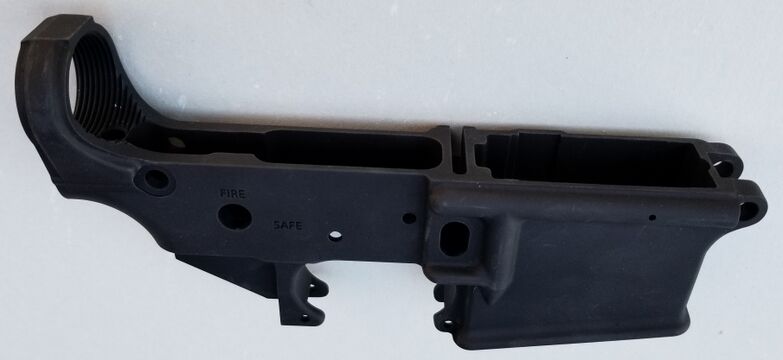 A stripped AR-15 lower receiver, showing the magazine well, fire-control pocket, threaded buffer-tube boss, and pin holes.
 -
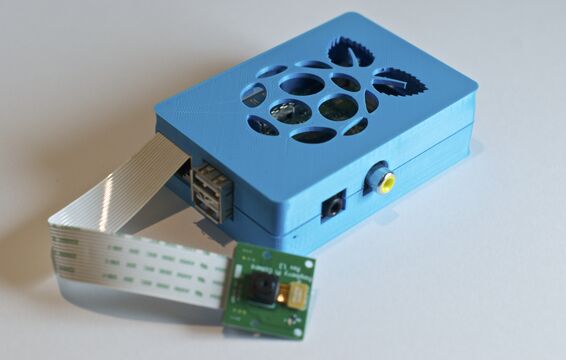 A 3D-printed Raspberry Pi enclosure: a rectangular polymer housing with cutouts for ports and a single-board computer.


Federal law regulates the frame or receiver as the firearm: 18 U.S.C. § 921(a)(3) includes "(B) the frame or receiver of any such weapon," and in Bondi v. VanDerStok the Supreme Court restated that a frame or receiver "is, even when sold separately, subject to the Act's requirements."[8][9] On the AR-15 the lower bears little of the firing stress. The Small Arms Survey described its role this way:
is primarily intended to ensure the correct alignment and interface of the operating parts of the firearm, and to house the trigger and fire selector and safety mechanisms.
Geometrically it is a polymer chassis with a rectangular magazine-well void, a smaller rectangular fire-control void, a threaded cylindrical boss at the rear, and a few through-holes for pins.
A 3D-printed enclosure for a single-board computer is a polymer chassis with a rectangular void for the board, a slot for ribbon cables or a battery, a threaded boss for mounting, and through-holes for screws. The shared primitives are hollow orthogonal boxes and a threaded cylinder. The defeat here is the split-file method described below: a receiver cut down its centerline into two halves, each an open shell that matches no whole-receiver signature, printed separately and bonded.
Pistol grip and power-tool handle
-
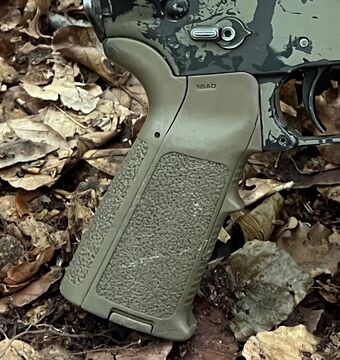 A Magpul MIAD pistol grip on an AR-15 lower receiver: an ergonomic, textured polymer handle.
 -
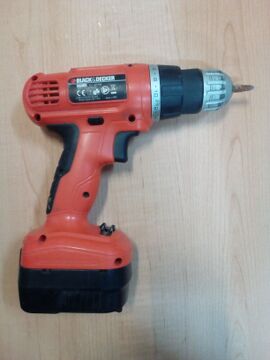 A cordless drill with a pistol-grip handle and a hollow core for the battery and motor.


An AR-15 pistol grip is an ergonomic handle: an elliptical sweep with finger contours, a hollow core, and a tang that bolts to the receiver. A replacement drill handle, an air-hammer grip, and a bicycle grip are the same elliptical sweep with finger contours and a hollow core. A model trained on overall hand-grip shape indexes on the morphology shared by every tool made to be held in a fist. The defeat is cosmetic: a heavy surface texture, a Voronoi pattern common in printed parts, or a rescale changes every vertex and defeats a fingerprint or a shape match while the mounting interface stays intact.
Glock frame and barcode-scanner handle
-
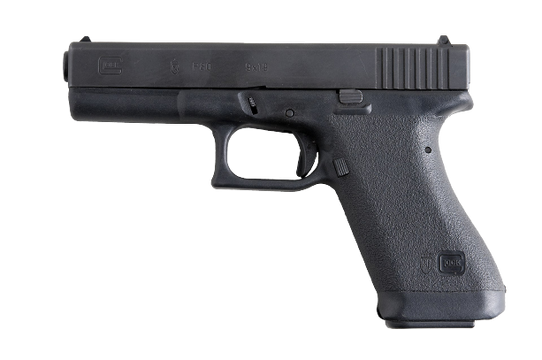 A Glock 17 pistol. The polymer frame carries the grip, trigger guard, and dust cover; it sets the grip angle, the trigger guard loop, and a hollow core.
 -
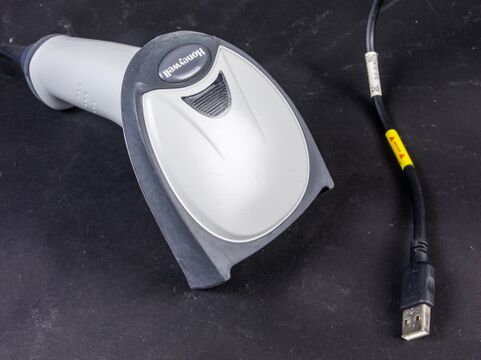 A Honeywell handheld barcode scanner with a pistol-grip handle and a trigger inside a guard loop.


The polymer frame of a Glock pistol sets the grip angle, the trigger guard loop, and a hollow core. A handheld barcode scanner has a grip set at a similar angle, a trigger inside a guard loop, and a hollow core for its electronics. This is the weakest pair of the set: a well-tuned classifier given enough resolution could separate the two on the detail of the slide rails, where the geometries differ. It is offered as the boundary case, the point at which the shapes begin to diverge, not as an equivalence. A classifier light enough to run on a consumer printer's controller, or one fed a low-resolution voxelization to save computation, gives up the fine detail that tells the two apart.
Additional geometric twins
Four further pairs make the same point but lack a freely licensed image to show both objects side by side.
The AR-15 lightning link and a flat slotted bracket. A lightning link is close to a two-dimensional part: a thin flat plate with a central rectangular slot and a small bent hook. A cabinet-latch plate, a leaf spring, and a slotted shim are flat plates with a slot and a tab. A builder can print the part slightly thicker than the working thickness and sand it down after printing, or print a solid blank scored with a break-away outline that hides the slot from the scanner.
The drop-in auto sear and a small pivot block. A drop-in auto sear body is a small rectangular block with a U-shaped channel and a transverse pin hole. Section 5845(b)'s definition of a machinegun reaches any "combination of parts designed and intended ... for use in converting a weapon into a machinegun."[7] A hinge base, a window-track stop, and a robotics pivot bracket are small blocks with a channel and a cross-hole. The builder prints a plain block and cuts the channel and the hole afterward with a hand drill and a rotary tool.
An SKS or AK conversion sear pairs with an angle bracket. This sear is a small bent strip of metal or polymer with one pivot hole, geometrically an L-bracket or a cantilever clip. The builder prints it flat, as a straight strip, then bends it to the working angle with heat after printing; the scanner sees a flat ruler.
The rifle magazine body and a parts hopper. A standard box-magazine body is a thin-walled curved box with internal guide ribs and feed lips at the top. A curved parts hopper or gravity dispenser is a thin-walled curved box with ribs. The feed lips are the one feature unique to the magazine, so a builder prints the body as a plain curved box and prints the feed lips as a separate small part to attach later.
The split-file defeat and the wrong chokepoint
The defeats above share a method. A restricted geometry is a set of voids and features assembled into one shape, and constructive solid geometry lets a builder take it apart. An AR-15 lower can be divided into the magazine well, the fire-control pocket, and the buffer-and-grip mount, each saved as its own file. Printed on separate days and then bolted or solvent-welded together, each file on its own is a plain box or block that no per-file scan recognizes as part of a firearm. To catch this, a scanner would have to track a user's whole print history and predict how separate shapes assemble in the physical world, which the per-file check the statute describes does not do.[1]
Behind the geometric problem sits a simpler one, developed in the companion essay: the part the printer makes is the part that bears the least stress. The frame or receiver is what federal law regulates, and it is also the only part a consumer printer can make, because fused-deposition plastic cannot contain the pressure of a fired cartridge.[10][8] The barrel, slide, and bolt that hold that pressure are unregulated components bought without a background check.[11][12] A 2024 study in Forensic Science International: Synergy catalogued 186 law-enforcement encounters with 3D-printed firearms and recorded only 14 involving fully printed guns.[13] A scanner that perfectly blocked every fully printed frame would leave the hybrid build, the kind that turns up in casework, untouched, because its pressure-bearing parts never pass through the printer.
Lawful channels still open before the mandate takes effect
The New York 3D printer blocking technology mandate is enacted but not yet in force, and the steps between enactment and an enforceable sales ban stay open to public participation. Governor Kathy Hochul signed the FY2026-2027 budget legislation carrying the provisions on May 27, 2026.[14] Two of its operative parts are scheduled rather than active. Executive Law § 837-aa, which defines the blocking technology and creates the working group, took effect on the day of enactment, but General Business Law § 396-eeee, the requirement that printers sold in New York carry blocking technology, "shall take effect one year after the promulgation of rules as provided for in subdivision 3 of section 837-aa of the executive law ..."[2] No such rules exist as of June 2026. The civil penalty attaches only to that dormant sales requirement: § 396-eeee(3) makes a "gun industry member" who violates the section "liable to the people of the state of New York" for a civil penalty of $5,000 for each qualified product unlawfully sold.[2]
The chain that has to finish before the sales ban can be enforced is set out in § 837-aa. The Division of Criminal Justice Services, the Department of State, and the State University of New York must convene a working group within ninety days of the section's effective date; the working group has up to one year from convening to make recommendations on minimum safety standards; DCJS then has up to nine months from receiving those recommendations to promulgate rules; and § 396-eeee takes effect one year after that.[2] If the agencies use the full time each step allows, the sales requirement would not take effect until roughly 2029, and only if the working group first finds the technology feasible.
The technological-feasibility clause
The statute makes the rulemaking turn on a feasibility finding by the working group. Executive Law § 837-aa(2) provides:
[I]f the working group determines that it is not technologically feasible to require three-dimensional printers sold in the state of New York to include blocking technology, the working group shall so report, and no regulations shall be required to be promulgated pursuant to this section, until such time as the working group determines that it is technologically feasible.
The DCJS rulemaking duty in § 837-aa(3) is itself written to operate only "unless the working group reports that it is not technologically feasible ..."[2] Because § 396-eeee takes effect only one year after rules are promulgated under § 837-aa(3),[2] and § 837-aa(2) provides that on an infeasibility report "no regulations shall be required to be promulgated,"[2] the one-year clock does not begin. The same clause keeps the requirement on the books: regulations stay required only "until such time as the working group determines that it is technologically feasible."[2]
That determination is the point where the technical objections in this essay and in the companion essay bear most directly, because the working group's answer to a single factual question, whether geometry scanning can be made to work, governs whether rules ever issue. The Electronic Frontier Foundation has called the scanning requirement "an unfeasible tech solution."[4] Phillip Torrone of the New York open-source hardware company Adafruit, whose analysis Techdirt reproduced, framed detection as a classification problem that would carry high false-positive and false-negative rates.[3]
Specific actions and the bodies that receive them
The most direct lawful channel is to put substantive technical evidence in front of the working group on the feasibility question. The group is convened by the Division of Criminal Justice Services, the Department of State, and the State University of New York, and § 837-aa(2) directs that its members have expertise in additive manufacturing technology, artificial intelligence and digital security, firearms regulation, public safety, and consumer product safety.[2] Written technical analyses addressed to those agencies, and oral testimony at the group's meetings, can document the geometric false-positive problem set out above, the open-source and offline-firmware compliance gap, and the hybrid-build point developed in the companion essay. The same membership clause supports a related step: asking the convening agencies to seat qualified technologists, such as additive-manufacturing engineers, open-source firmware maintainers, and university and makerspace engineering staff.[2]
If the working group clears the feasibility hurdle and DCJS publishes a notice of proposed rule making, the rule is made under the State Administrative Procedure Act, which opens a separate comment channel. SAPA § 202 sets a public comment period of not less than sixty days after the notice is published, and requires the agency to publish an assessment of public comment that summarizes and analyzes the issues raised and the significant alternatives suggested, and states why any significant alternative was not adopted.[15] A comment that raises a significant technical alternative falls within that required assessment. No comment docket is open until a notice of proposed rule making is published.
Opposition can also be registered through official channels with the offices responsible for the law. The Department of State, whose Secretary of State is Walter T. Mosley, co-convenes the working group and publishes the State Register in which any rulemaking notice would appear.[16] DCJS maintains a public contact page,[17] and the Office of the Governor accepts messages through its official contact form.[18] These channels take a specific, technical message from an identified New York resident or business.
Two further avenues build the longer record. The Electronic Frontier Foundation's campaign "Stop New York's Attack on 3D Printing" coordinates public opposition and provides tools to contact elected officials,[4] and Adafruit, a New York open-source hardware manufacturer, has opposed the law through the technical critique it published.[3] Separately, a New Yorker can ask a state senator or assembly member to introduce or support an amendment or repeal of § 837-aa or § 396-eeee; that route requires new legislation, while the feasibility determination is a decision the enacted statute already assigns to the working group.[2]
See also
References
- ↑ 1.0 1.1 1.2 "Senate Bill S9005C, FY2026-2027 budget (Public Protection and General Government), Part C". New York State Senate. 2026-05-27. Retrieved 2026-06-01. The § 837-aa(1)(b) blocking-technology definition, the § 837-aa(1)(c) firearms blueprint detection algorithm and STL/CAD/geometric-code clause appear on this page.
- ↑ 2.00 2.01 2.02 2.03 2.04 2.05 2.06 2.07 2.08 2.09 2.10 2.11 2.12 "Enacted text of A. 10005-C / S. 9005-C, FY2026-2027 budget, Part C" (PDF). New York State Assembly. 2026-05-27. Retrieved 2026-06-01. The enacted text contains the § 837-aa(2) working group, its ninety-day convening interval, one-year recommendation interval, member-expertise list, and technological-feasibility clause; the § 837-aa(3) DCJS rulemaking duty (within nine months of receiving recommendations) and its "unless the working group reports that it is not technologically feasible" condition; the § 837-aa(3)(b) library clause directing the Division of Criminal Justice Services to maintain blueprint files "including scans of seized firearms"; the § 396-eeee(3) civil penalty of $5,000 per qualified product against a "gun industry member"; and the Subpart B § 6 clause providing that § 396-eeee "shall take effect one year after the promulgation of rules as provided for in subdivision 3 of section 837-aa of the executive law."
- ↑ 3.0 3.1 3.2 3.3 3.4 Karl Bode (2026-02-19). "New York's New 3D Printing Law, As Written, Is Extremely Harmful And Annoying". Techdirt. Retrieved 2026-06-01. Reproduces Adafruit's Phillip Torrone on the classification problem (identifying firearm parts from STL and G-code without flagging common shapes; high false-positive and false-negative rates) and on G-code as tool paths rather than labeled parts.
- ↑ 4.0 4.1 4.2 Rory Mir and Nathan Sheard (2026-04-16). "Stop New York's Attack on 3D Printing". Electronic Frontier Foundation. Retrieved 2026-06-01. Characterizes the scanning requirement as "an unfeasible tech solution."
- ↑ 5.0 5.1 "US Patent 7,987,944 B1, Firearm sound suppressor baffle". United States Patent and Trademark Office. 2011-08-02. Retrieved 2026-06-01. Figures show a conical bell with a central aperture and a rear plate within an outer tube.
- ↑ Nikola Tesla (1920-02-03). "US Patent 1,329,559, Valvular Conduit". United States Patent and Trademark Office. Retrieved 2026-06-01. Drawings show internal cones and buckets that pass fluid one way and resist it the other, with no moving parts.
- ↑ 7.0 7.1 "26 U.S.C. § 5845, Definitions". Legal Information Institute, Cornell Law School. 2024. Retrieved 2026-06-01. Defines a machinegun to include "any part designed and intended solely and exclusively, or combination of parts designed and intended, for use in converting a weapon into a machinegun."
- ↑ 8.0 8.1 "18 U.S.C. § 921, Definitions". Legal Information Institute, Cornell Law School. 2024. Retrieved 2026-06-01. Defines a firearm to include "(B) the frame or receiver of any such weapon."
- ↑ "Bondi v. VanDerStok, No. 23-852" (PDF). Supreme Court of the United States. 2025-03-26. Retrieved 2026-06-01. States that a frame or receiver "is, even when sold separately, subject to the Act's requirements."
- ↑ 10.0 10.1 N.R. Jenzen-Jones (2015). "Behind the Curve: New Technologies, New Control Challenges (Occasional Paper 32)" (PDF). Small Arms Survey. Retrieved 2026-06-01. States that the AR-15 lower receiver "is primarily intended to ensure the correct alignment and interface of the operating parts of the firearm, and to house the trigger and fire selector and safety mechanisms."
- ↑ "Assembly Bill 1089 committee analysis (citing U.S. Department of Justice Office of the Inspector General cost estimate)" (PDF). California State Assembly Committee on Public Safety. 2023. Retrieved 2026-06-01. Describes building a printed handgun by "3D printing a 9 millimeter handgun frame and adding unregulated firearm components (such as the barrel, trigger, slide, magazine, etc.)."
- ↑ Andy Greenberg (2025-05-19). "We Built the Ghost Gun Luigi Mangione Allegedly Used, and Tested It". WIRED. Retrieved 2026-06-01. Itemizes a hybrid build in which the slide, barrel, and trigger components are purchased metal parts while only the frame is printed.
- ↑ "The emergence of 3D-printed firearms: An analysis of media and law enforcement reports". Forensic Science International: Synergy. 2024. Retrieved 2026-06-01. Catalogues 186 law-enforcement encounters with 3D-printed firearms, of which the fully-3D-printed category is the smallest object type at 14 cases.
- ↑ "Keeping New Yorkers Safe: Governor Hochul Signs Legislation to Strengthen Public Safety". Office of Governor Kathy Hochul. 2026-05-27. Retrieved 2026-06-02. Announces the May 27, 2026 signing of the FY2026-2027 budget legislation, including the 3D-printer minimum-safety-standard provisions and the working group that is to develop regulations.
- ↑ "State Administrative Procedure Act § 202, Rule making procedure". New York State Senate. 2024. Retrieved 2026-06-02. Subdivision 1(a) requires a public comment period of not less than sixty days after publication of a notice of proposed rule making; subdivision 5(b) requires an assessment of public comment that summarizes and analyzes the issues raised and the significant alternatives suggested and states why any significant alternative was not adopted.
- ↑ "Our Executive Team". New York State Department of State. Retrieved 2026-06-02. Identifies Walter T. Mosley as Secretary of State.
- ↑ "Contact DCJS". New York State Division of Criminal Justice Services. Retrieved 2026-06-02. Official public contact page for the Division of Criminal Justice Services.
- ↑ "Send a Message to the Governor". Office of Governor Kathy Hochul. Retrieved 2026-06-02. Official form for members of the public to send a message to the Governor of New York.