
Verizon demo phone MDM data wipe: Difference between revisions
No edit summary Tags: Reverted Mobile edit Mobile web edit |
Tag: Rollback |
||
| (5 intermediate revisions by one other user not shown) | |||
| Line 1: | Line 1: | ||
{{#seo: | |||
|description=Verizon sent a customer an unwiped store demo phone with active device management that remotely erased his data, then demanded a legal order to explain. | |||
}} | |||
{{IncidentCargo | |||
|Company=Verizon | |||
|StartDate=2026-02 | |||
|EndDate= | |||
|Status=Active | |||
|ProductLine= | |||
|Product= | |||
|ArticleType=Service | |||
|Type=Privacy,Data Security | |||
|Description=Verizon sent a customer a demo phone with active MDM that remotely wiped his data; the carrier demanded a legal order to disclose what it did | |||
}} | |||
== | In February 2026, Verizon sent longtime customer Tom Collery a replacement Samsung Galaxy Z Flip7 that was an unwiped store demonstration unit still enrolled in Verizon's mobile device management (MDM) system.<ref name="ars">{{Cite web |last=Brodkin |first=Jon |title=Verizon sent man a refurbished phone with MDM, then deleted his data remotely |work=Ars Technica |date=2026-06-12 |url=https://arstechnica.com/tech-policy/2026/06/verizon-sent-man-a-refurbished-phone-with-mdm-then-deleted-his-data-remotely/ |access-date=2026-06-13}}</ref> About two weeks later the phone reset itself remotely, erasing everything Collery had moved onto it, including contacts, messages, photos, documents, healthcare information he used for work, & the last video he had of his grandmother before she died.<ref name="ars" /> When he asked Verizon what the management software had recorded & which account issued the command to wipe his device, an executive-relations representative told him the company would require a legal order before disclosing any details.<ref name="ars" /> Verizon gave him a $400 credit, sent a second refurbished phone without the management profile, & told the [[Federal Communications Commission]] it considered the case resolved.<ref name="ars" /> | ||
Collery, who lives in San Francisco & works in healthcare, says he had been a [[Verizon]] customer for 22 years.<ref name="ars" | == Background == | ||
Collery, who lives in San Francisco & works in healthcare, says he had been a [[Verizon]] customer for 22 years.<ref name="ars" /> In February 2026 he called the carrier about network problems including dropped calls, & Verizon shipped him a replacement for his phone, a [[Samsung]] Galaxy Z Flip7.<ref name="ars" /> Instead of a new device or a properly reset refurbished one, the phone he received was a store demo unit that had not been wiped before shipping. It carried the same kind of software that company IT departments use to monitor & control phones issued to employees.<ref name="ars" /> | |||
After the device later reset, on-screen messages made its status explicit. One read ''This device is managed. Property of Verizon has configured this device to be fully managed.'' Others said ''Device owned by Verizon'' & ''Protected with BricTECH.''<ref name="ars" /> BricTECH is a retail security & device-management product made by Sennco Solutions, an InVue company; Sennco markets it for managing company-owned devices & securing store display phones, & states that it supports Android.<ref name="sennco-brictech">{{Cite web |title=BricTECH |work=Sennco Solutions |url=https://sennco.com/product/brictech/ |access-date=2026-06-13}}</ref> Sennco's privacy policy for the BricTECH retail app describes an automatic reset routine for demonstration devices: | After the device later reset, on-screen messages made its status explicit. One read ''This device is managed. Property of Verizon has configured this device to be fully managed.'' Others said ''Device owned by Verizon'' & ''Protected with BricTECH.''<ref name="ars" /> BricTECH is a retail security & device-management product made by Sennco Solutions, an InVue company; Sennco markets it for managing company-owned devices & securing store display phones, & states that it supports Android.<ref name="sennco-brictech">{{Cite web |title=BricTECH |work=Sennco Solutions |url=https://sennco.com/product/brictech/ |access-date=2026-06-13}}</ref> Sennco's privacy policy for the BricTECH retail app describes an automatic reset routine for demonstration devices: | ||
| Line 17: | Line 32: | ||
[[File:Verizon-mdm-android-management-deprovision-wipe.png|thumb|center|upright=2.4|Google's Android Management API documents that the WIPE command triggers a factory reset on a company-owned device.]] | [[File:Verizon-mdm-android-management-deprovision-wipe.png|thumb|center|upright=2.4|Google's Android Management API documents that the WIPE command triggers a factory reset on a company-owned device.]] | ||
==Remote factory reset & data loss== | == Remote factory reset & data loss == | ||
The demo unit did not fix Collery's network problems, but it worked at first. He transferred his data to it & returned his original phone.<ref name="ars" /> After about ten days the phone began repeatedly installing security updates & restarting, & within a few more days it restarted as though it had been factory reset.<ref name="ars" /> Collery could no longer sign in to his Google or Samsung accounts; the device told him he did not have permission & to contact his IT administrator.<ref name="ars" /> | The demo unit did not fix Collery's network problems, but it worked at first. He transferred his data to it & returned his original phone.<ref name="ars" /> After about ten days the phone began repeatedly installing security updates & restarting, & within a few more days it restarted as though it had been factory reset.<ref name="ars" /> Collery could no longer sign in to his Google or Samsung accounts; the device told him he did not have permission & to contact his IT administrator.<ref name="ars" /> | ||
| Line 26: | Line 41: | ||
Cooper Quintin, a security researcher & senior technologist at the Electronic Frontier Foundation, told Ars Technica that the restarts & reset were consistent with Verizon pushing instructions to a group of managed devices at once. He said that with a fleet of demo phones under MDM, ''you're just sending instructions to all the phones,'' & that if Verizon wipes demo units on a schedule, the timing may have been the policy taking effect.<ref name="ars" /> Verizon advised Collery to take the phone to a uBreakiFix store, but a technician there could not recover any data because of the management profile.<ref name="ars" /> | Cooper Quintin, a security researcher & senior technologist at the Electronic Frontier Foundation, told Ars Technica that the restarts & reset were consistent with Verizon pushing instructions to a group of managed devices at once. He said that with a fleet of demo phones under MDM, ''you're just sending instructions to all the phones,'' & that if Verizon wipes demo units on a schedule, the timing may have been the policy taking effect.<ref name="ars" /> Verizon advised Collery to take the phone to a uBreakiFix store, but a technician there could not recover any data because of the management profile.<ref name="ars" /> | ||
==Verizon's response== | == Verizon's response == | ||
===Letter to the FCC=== | === Letter to the FCC === | ||
After Collery complained to the FCC, Verizon's executive relations department sent the agency a letter dated April 2, 2026, which he shared with Ars Technica. The letter acknowledged the mistake: | After Collery complained to the FCC, Verizon's executive relations department sent the agency a letter dated April 2, 2026, which he shared with Ars Technica. The letter acknowledged the mistake: | ||
| Line 36: | Line 51: | ||
<blockquote>''The Executive Office has advised that all Certified devices originate directly from the manufacturer and are designed to meet stringent quality assurance standards.''</blockquote><ref name="ars" /> The letter said Collery had received compensation exceeding $400 before he filed the complaint, that no further credits would be issued, & that the executive office ''considers this case as resolved.''<ref name="ars" /> Verizon's only statement to Ars Technica, in the seven weeks after it was contacted, was that it was ''aware of this customer's concern'' & working to address it.<ref name="ars" /> The carrier did not say who handles its phone refurbishment or how the management profile survived its inspection process.<ref name="ars" /> | <blockquote>''The Executive Office has advised that all Certified devices originate directly from the manufacturer and are designed to meet stringent quality assurance standards.''</blockquote><ref name="ars" /> The letter said Collery had received compensation exceeding $400 before he filed the complaint, that no further credits would be issued, & that the executive office ''considers this case as resolved.''<ref name="ars" /> Verizon's only statement to Ars Technica, in the seven weeks after it was contacted, was that it was ''aware of this customer's concern'' & working to address it.<ref name="ars" /> The carrier did not say who handles its phone refurbishment or how the management profile survived its inspection process.<ref name="ars" /> | ||
===Refusal to disclose MDM records=== | === Refusal to disclose MDM records === | ||
Collery asked Verizon for records of what personal information the MDM software had recorded & what commands had been sent to the device. A Verizon executive-relations representative answered by email on May 12, 2026: | Collery asked Verizon for records of what personal information the MDM software had recorded & what commands had been sent to the device. A Verizon executive-relations representative answered by email on May 12, 2026: | ||
| Line 48: | Line 63: | ||
</gallery> | </gallery> | ||
==Consumer response== | == Consumer response == | ||
Verizon offered to waive Collery's remaining device payments to end the dispute, & a representative asked whether that would be enough for him to walk away.<ref name="ars" /> He declined. He sent Verizon a formal request for his data under the CCPA, submitted a notice of dispute as a prerequisite to arbitration, & said he was weighing a small-claims case, telling Verizon it was hard to negotiate while the company refused to confirm what information had left his device or who ordered it deleted.<ref name="ars" /> The network problems that started the dispute were never fixed. ''My service is still abysmal,'' Collery said. ''I can't even get a GPS signal in front of my building.''<ref name="ars" /> | Verizon offered to waive Collery's remaining device payments to end the dispute, & a representative asked whether that would be enough for him to walk away.<ref name="ars" /> He declined. He sent Verizon a formal request for his data under the CCPA, submitted a notice of dispute as a prerequisite to arbitration, & said he was weighing a small-claims case, telling Verizon it was hard to negotiate while the company refused to confirm what information had left his device or who ordered it deleted.<ref name="ars" /> The network problems that started the dispute were never fixed. ''My service is still abysmal,'' Collery said. ''I can't even get a GPS signal in front of my building.''<ref name="ars" /> | ||
==See also== | == See also == | ||
*[[Right to Repair]] | * [[Right to Repair]] | ||
==References== | == References == | ||
{{reflist}} | {{reflist}} | ||
[[Category:Verizon]] | [[Category:Verizon]] | ||
[[Category:Privacy]] | [[Category:Privacy]] | ||
Latest revision as of 02:19, 15 June 2026
In February 2026, Verizon sent longtime customer Tom Collery a replacement Samsung Galaxy Z Flip7 that was an unwiped store demonstration unit still enrolled in Verizon's mobile device management (MDM) system.[1] About two weeks later the phone reset itself remotely, erasing everything Collery had moved onto it, including contacts, messages, photos, documents, healthcare information he used for work, & the last video he had of his grandmother before she died.[1] When he asked Verizon what the management software had recorded & which account issued the command to wipe his device, an executive-relations representative told him the company would require a legal order before disclosing any details.[1] Verizon gave him a $400 credit, sent a second refurbished phone without the management profile, & told the Federal Communications Commission it considered the case resolved.[1]
Background
[edit | edit source]Collery, who lives in San Francisco & works in healthcare, says he had been a Verizon customer for 22 years.[1] In February 2026 he called the carrier about network problems including dropped calls, & Verizon shipped him a replacement for his phone, a Samsung Galaxy Z Flip7.[1] Instead of a new device or a properly reset refurbished one, the phone he received was a store demo unit that had not been wiped before shipping. It carried the same kind of software that company IT departments use to monitor & control phones issued to employees.[1]
After the device later reset, on-screen messages made its status explicit. One read This device is managed. Property of Verizon has configured this device to be fully managed. Others said Device owned by Verizon & Protected with BricTECH.[1] BricTECH is a retail security & device-management product made by Sennco Solutions, an InVue company; Sennco markets it for managing company-owned devices & securing store display phones, & states that it supports Android.[2] Sennco's privacy policy for the BricTECH retail app describes an automatic reset routine for demonstration devices:
Sennco DPC may sanitize devices on a predetermined schedule to give the end user a standardized experience. Sanitization may include resetting specific applications data and cache, clearing contacts, clearing sms messages and clearing call logs.
-
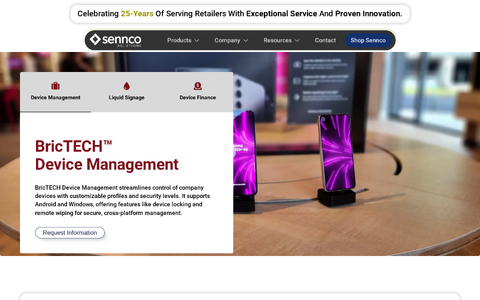 Sennco markets BricTECH Device Management for controlling company-owned phones and securing store display units, and states it supports Android with remote wiping.
 -
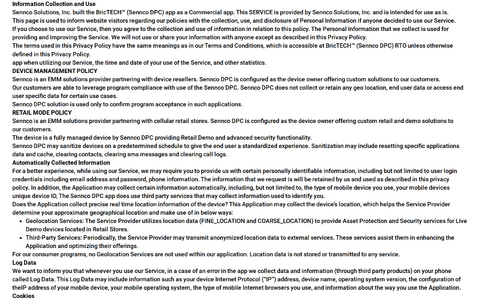 Sennco's BricTECH retail app privacy policy states the software may sanitize demo devices on a schedule, clearing contacts, SMS messages, and call logs.


A device enrolled in MDM as a fully managed device can be erased from a server. In Google's Android Management API, the enterprises.devices.delete method, one of the API's deprovisioning methods, immediately deletes the device record & sends a wipe instruction; for a company-owned device that instruction triggers a factory reset.[4]

Remote factory reset & data loss
[edit | edit source]The demo unit did not fix Collery's network problems, but it worked at first. He transferred his data to it & returned his original phone.[1] After about ten days the phone began repeatedly installing security updates & restarting, & within a few more days it restarted as though it had been factory reset.[1] Collery could no longer sign in to his Google or Samsung accounts; the device told him he did not have permission & to contact his IT administrator.[1]
His cloud backups turned out to be less complete than he had assumed, so the wipe was not recoverable. In a phone interview he described what was gone:
I lost everything. Contacts, messages, videos, documents, pictures, everything from patient information to the last video I have with my grandmother before she died.
Cooper Quintin, a security researcher & senior technologist at the Electronic Frontier Foundation, told Ars Technica that the restarts & reset were consistent with Verizon pushing instructions to a group of managed devices at once. He said that with a fleet of demo phones under MDM, you're just sending instructions to all the phones, & that if Verizon wipes demo units on a schedule, the timing may have been the policy taking effect.[1] Verizon advised Collery to take the phone to a uBreakiFix store, but a technician there could not recover any data because of the management profile.[1]
Verizon's response
[edit | edit source]Letter to the FCC
[edit | edit source]After Collery complained to the FCC, Verizon's executive relations department sent the agency a letter dated April 2, 2026, which he shared with Ars Technica. The letter acknowledged the mistake:
We acknowledge the seriousness of the error that led to Mr. Collery receiving a device subsequently identified as a 'demo phone,' which was found to have a Mobile Device Management (MDM) registration linked to Verizon. This procedural lapse has been formally submitted for internal investigation.
A Verizon supervisor had earlier assured Collery that refurbished phones are like new & pass a 150-point inspection.[1] In the same letter Verizon defended its supply chain to the FCC:
The Executive Office has advised that all Certified devices originate directly from the manufacturer and are designed to meet stringent quality assurance standards.
[1] The letter said Collery had received compensation exceeding $400 before he filed the complaint, that no further credits would be issued, & that the executive office considers this case as resolved.[1] Verizon's only statement to Ars Technica, in the seven weeks after it was contacted, was that it was aware of this customer's concern & working to address it.[1] The carrier did not say who handles its phone refurbishment or how the management profile survived its inspection process.[1]
Refusal to disclose MDM records
[edit | edit source]Collery asked Verizon for records of what personal information the MDM software had recorded & what commands had been sent to the device. A Verizon executive-relations representative answered by email on May 12, 2026:
I received word back from the Legal team. In order to provide any details about the MDM, we would require a legal order.
Collery replied on May 13 that the California Consumer Privacy Act requires a business to disclose the personal information it collects about a consumer when the consumer asks for it, & he warned that California's invasion-of-privacy statute provides for damages of $5,000 per violation.[1] The CCPA gives a consumer the right to request that a business disclose the categories of personal information it collected, the sources & purposes, the categories of third parties that received it, & [t]he specific pieces of personal information it has collected about that consumer.[5][6] California Penal Code section 637.2 lets a person injured by a violation of the state's invasion-of-privacy law recover the greater of $5,000 per violation or three times actual damages.[7]
-
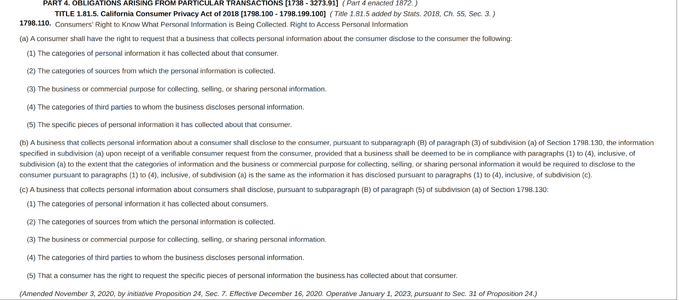 California Civil Code section 1798.110 gives a consumer the right to obtain the specific pieces of personal information a business has collected about them.
 -
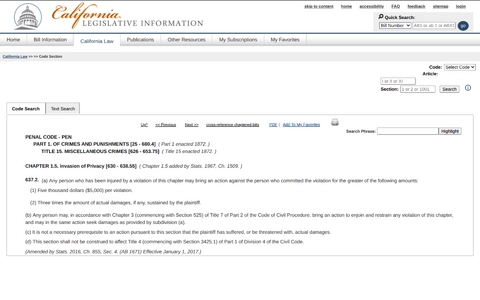 California Penal Code section 637.2 lets a person injured by an invasion-of-privacy violation recover the greater of $5,000 per violation or three times actual damages.


Consumer response
[edit | edit source]Verizon offered to waive Collery's remaining device payments to end the dispute, & a representative asked whether that would be enough for him to walk away.[1] He declined. He sent Verizon a formal request for his data under the CCPA, submitted a notice of dispute as a prerequisite to arbitration, & said he was weighing a small-claims case, telling Verizon it was hard to negotiate while the company refused to confirm what information had left his device or who ordered it deleted.[1] The network problems that started the dispute were never fixed. My service is still abysmal, Collery said. I can't even get a GPS signal in front of my building.[1]
See also
[edit | edit source]References
[edit | edit source]- ↑ 1.00 1.01 1.02 1.03 1.04 1.05 1.06 1.07 1.08 1.09 1.10 1.11 1.12 1.13 1.14 1.15 1.16 1.17 1.18 1.19 1.20 1.21 1.22 1.23 1.24 Brodkin, Jon (2026-06-12). "Verizon sent man a refurbished phone with MDM, then deleted his data remotely". Ars Technica. Retrieved 2026-06-13.
- ↑ "BricTECH". Sennco Solutions. Retrieved 2026-06-13.
- ↑ "BricTECH RTO App Privacy Policy". Sennco Solutions. Retrieved 2026-06-13.
- ↑ "Deprovision a device". Android Management API, Google for Developers. Retrieved 2026-06-13.
- ↑ "California Civil Code section 1798.110". California Legislative Information. Retrieved 2026-06-13.
- ↑ "California Consumer Privacy Act (CCPA)". California Office of the Attorney General. 2024-03-13. Retrieved 2026-06-13.
- ↑ "California Penal Code section 637.2". California Legislative Information. Retrieved 2026-06-13.