
User:Louis/Rebuttal to the ESA on AB 1921 and Stop Killing Games
On March 31, 2024, Ubisoft turned off the servers for The Crew.[1] The game went dark, including the single-player campaign that never needed other people to play; it was online-only, so nothing worked once the servers were gone.[2] Days later, Ubisoft revoked the license from players' own libraries, so people who paid for the game no longer owned a copy of anything.[2] You bought a racing game in 2014 and in 2024 a remote switch deleted it.[1]
That is what the Entertainment Software Association is in California to defend. Stan Pierre-Louis, the ESA's president, wrote an op-ed in the Sacramento Bee calling Assembly Bill 1921 misguided.[3] Strip away the language about innovation and infrastructure and the position is simple: a company should be able to sell you a finished product, take your money, and then switch it off whenever the spreadsheet says so. The bill says no. I think the bill is right, and I think the ESA's argument falls apart claim by claim.
So let us go through it.
The bill does not say "run it forever." It gives three exits, and one of them is just a refund
[edit | edit source]The ESA's central claim:
"Under Assembly Bill 1921, the Protect Our Games Act, when a game publisher decides to shut down a "server-connected" digital game, developers would be forced to choose between keeping it running indefinitely, rebuilding the game to work without technical support or providing a full refund to everyone..."[3]
"Keeping it running indefinitely" is not in the bill. The bill exists to let publishers avoid this obligation. Read the actual statutory text.[4] When an operator ends the services a game needs for ordinary use, it has to provide at least one of three things: a standalone version that works without the operator's servers, a patch or update that lets the game keep working without those servers, or a refund equal to the full purchase price. The publisher picks which one.

The ESA listed "keep it running indefinitely" first and "rebuild" second and made the refund sound like a doomsday. The bill lists the patch and the standalone build as the normal path and the refund as the fallback. Same three slots, opposite emphasis. The publisher chooses, and "leave the lights on forever" was never on the menu.
There is also a notice duty the op-ed skips. The publisher has to warn players at least 60 days before shutdown, in the game and on the website, stating the date services end, which features die, any known security risks, and how to keep playing or get the refund.[4] That is not a demand for eternal service. That is a demand to stop ambushing people who paid you.

The bill covers remasters and re-releases, and the ESA is right about that
[edit | edit source]"The legislation would apply to both new video games and existing games that are remastered or re-released."[3]
This is accurate, and I will say so plainly. The bill's scope clause applies to a digital game first available for purchase or rereleased for purchase on or after January 1, 2027.[4] A re-release after that date is in. The "rereleased" hook is deliberate, so a publisher cannot dodge the law by re-selling an old title under a new SKU.

But notice what that same clause does. It is prospective. It grandfathers every game already on the market. Nobody is forcing a retrofit of an existing MMO that was architected ten years ago. The ESA presents the scope as alarming reach. The scope is a narrow, forward-looking rule that gives every publisher more than half a year of lead time to design an end-of-life plan or price the refund risk into a 2027 release.
"Access forever" is the ESA's words, not the bill's
[edit | edit source]"The bill, authored by Assemblymember Chris Ward, D-San Diego, intends to provide consumers with a guarantee that if they pay for access to play an online game, they will keep that access for as long as they want."[3]
The bill's own author frames it differently. The committee analysis describes the operator's duty on shutdown as a patch, a "copy of the game capable of being used in the absence of those services", or a full refund.[5] The same analysis records the author's statement that the bill protects people who "purchased a license with the expectation of continual access" and ensures they "walk away with either a playable version of the game or a refund once services cease."[5]

That is not "access for as long as they want". That is: when you pull the plug, the buyer keeps something playable or gets their money back. The whole movement behind this asks for exactly that and nothing more. Stop Killing Games, the campaign that grew out of The Crew's shutdown, supports publishers ending support for a game whenever they choose; what it asks for is an end-of-life plan so the game can run on players' own systems without the company.[6] The European citizens' initiative behind the same idea asks only for "reasonable means to continue functioning of said videogames without the involvement from the side of the publisher," leaving each game "in a reasonably functional (playable) state."[7] The "forever" is the ESA's invention. It is the one claim every later argument in the op-ed leans on, and it is not real.
"Nearly the same cost" is wrong about how cloud servers bill, and the rest is a one-time job
[edit | edit source]"When a game's popularity fades, that infrastructure continues to run, for a fraction of the audience, at nearly the same cost."[3]
Compute does not bill that way. Amazon's GameLift service auto-scales game servers and runs zero instances when there is no game-session activity, which removes compute cost during inactivity; as the audience shrinks, the match-processing cost falls with it.[8] It does not sit at "nearly the same cost".

I will concede the honest part. There is a fixed floor: persistent databases, flat-fee anti-cheat and middleware licenses, and a skeleton security and operations crew that does not scale down to nothing. A near-empty game that you insist on keeping fully live is still uneconomic to host. That is a real cost.
But that cost is an argument for the exit ramp, not for killing the product. The bill's answer to "the live floor costs money" is: then stop running it live. Ship the offline patch. Hand it off. The end-of-life obligation is a one-time engineering expense, not a perpetual operating bill. It is cheap when the studio designed for it and expensive only when it has to untangle tightly coupled proprietary cloud services after the fact. Industry commentary lands in the same place: the analyst George Osborn called the idea that services must run in some form in perpetuity forever "bonkers," and developers quoted alongside him put the real difficulty in decoupling external micro-services for an offline build, not in any law of physics.[9]
This is not theory. Studios with far less money than Ubisoft have already done the handoff:
- Velan Studios released a free standalone "Private Server Edition" of Knockout City for Windows, almost all cosmetics unlocked, microtransactions stripped out, with player-hosted and LAN servers, and kept it available when it shut the public servers down on June 6, 2023.[10] An indie studio did that with limited resources.
- Sony's Polyphony Digital patched Gran Turismo Sport on January 31, 2024 to remove the always-online requirement so the single-player campaign and progression save locally.[11]
- Capcom released a paid offline version of Mega Man X DiVE on September 1, 2023, before shutting the free-to-play online service.[12]
None of these companies went bankrupt giving players a way to keep what they bought.
The "two-thirds under 10 employees" stat is real and aimed at the wrong target
[edit | edit source]"nearly two thirds of video game software companies in the U.S. operate with less than 10 employees."[3]
This number is true. It comes from the ESA's own 2026 Essential Facts report, which puts 65% of the software sector at fewer than 10 employees.[13] I am not going to dispute the ESA's own figure. I am going to point out who it does not describe.
The same report says 29% of the industry workforce sits in eight sites of 1,000 or more employees.[13] The games that get killed off and started this whole fight are not made by 10-person shops. The Crew is Ubisoft. Concord is Sony. Babylon's Fall is Square Enix and PlatinumGames, shut down less than a year after launch.[14] Anthem is EA.[15] Those are the multinationals the bill reaches on premium buy-to-play titles. Using micro-studio demographics as a human shield for billion-dollar publishers is the trick here. And the free-to-play and mobile work that most of those tiny studios do is exempt from the bill anyway.[4]

The car-and-phone analogy compares ending support to remote-detonating the engine
[edit | edit source]"We don't expect innovators to continue supporting their very first car model, their original smartphone or an outdated operating system software, but this bill suggests that online video games should last forever."[3]
This is the sharpest-sounding line in the op-ed and it is the weakest. It confuses ending support with revoking function. When a carmaker stops supporting a model, the car still drives. When Microsoft ended Windows 7 support, the machines still booted. A phone past its last OS update still runs your local apps, takes photos, makes calls. Support ended; the thing you bought kept working.
A server-killed online-only game does the opposite. The Crew did not "lose support." It became a brick, including the single-player campaign that needed no support at all.[2] Nobody is asking Ford to service a 2005 sedan forever. We are saying Ford should not be allowed to reach into your driveway and disable the engine by remote signal. The bill and the European initiative ask for preserved function, not infinite support.[7] The analogy proves the bill's point.

"Unprecedented category" is false, and several existing laws already impose post-sale duties
[edit | edit source]"AB 1921 bill creates an entirely new, unprecedented category of consumer products."[3]
The committee analysis notes that many of AB 1921's definitions are "shared with AB 2426."[5] AB 2426 is California's 2024 digital-goods law, in effect since January 1, 2025, that bars a seller from using "buy" or "purchase" for a revocable license unless the buyer affirmatively acknowledges the good is a revocable license, or the seller gives a clear and conspicuous pre-purchase disclosure, in plain language, with a link to the terms.[16] It folds that rule into the state False Advertising Law, which carries civil penalties up to $2,500 per violation.[17] So the legislature already wrote a law about exactly this gap, and AB 1921 builds on its framework.

Post-sale duties are not new anywhere. California's SB 244 right-to-repair law, effective July 1, 2024, makes manufacturers supply parts, tools, and documentation for years after the last unit is made.[18] The EU repair directive requires spare-parts availability for years on covered goods.[19] The Magnuson-Moss Warranty Act,[20] the California Consumers Legal Remedies Act,[21] and Section 5 of the FTC Act[22] all already regulate what a seller owes after the sale.
And bricking a product by killing its cloud server is a problem regulators and courts have already seen. Google's Nest bricked the Revolv smart-home hub on May 15, 2016,[23] a $300 device sold with a lifetime subscription.[24] Sonos pushed a "Recycle Mode" in 2020 that irreversibly bricked working speakers, then reversed after backlash.[25] Insteon abruptly shut its hubs in mid-April 2022 with no warning.[26] Spotify deactivated the Car Thing on December 9, 2024[27] and, facing a class action, offered refunds to buyers.[28] "Unprecedented" is not the word.
This is not a California fringe idea either. The European citizens' initiative behind the same principle gathered 1,294,188 validated signatures and crossed the required threshold in 24 member states,[29] and was submitted to the European Commission on January 26, 2026.[7]
Time-limited licenses are a risk publishers choose, and they already handle it with patches and delisting
[edit | edit source]"many of today's popular games include licensed music, likeness rights and branding that might be time-limited. A legal requirement to keep games playable indefinitely will put game publishers in an impossible situation where they are either renegotiating licenses in perpetuity or altering games to change the creator's original intent and gameplay experience."[3]
The "impossible situation" rests on the "indefinitely" strawman that already collapsed. The bill never requires perpetual playability with frozen assets. It lets a publisher ship a final patch that removes or swaps an expired track, hand off a server build, or refund.[4] Refunding involves no alteration of anything.
Publishers do the patch-and-swap move already. Remedy de-listed Alan Wake in 2017 over expiring music and relisted it in 2018,[30] then in 2024 patched out David Bowie's "Space Oddity" and replaced it with an original track after the song's license changed.[31] Microsoft de-listed Forza Horizon 4 on December 15, 2024 over licensing while letting existing owners keep full offline, online, and multiplayer access.[32] Time-limited licenses are a foreseeable, publisher-chosen risk that the industry already manages by patching or de-listing. The bill asks them to manage it on the way out the door too.
"Direct conflict with copyright" is wrong, and the copyright angle cuts against the ESA
[edit | edit source]"This comes at great expense to the original creators and is in direct conflict with the basic principles of America's longstanding copyright laws."[3]
Federal copyright preemption under 17 U.S.C. 301 asks whether a state law vindicates rights equivalent to copyright's exclusive rights.[33] AB 1921 does not regulate copying, distribution, or derivative works. It regulates the terms of a sale: disclosure, a playable handoff, or a refund. That is the "extra element" that defeats preemption. The Seventh Circuit held in ProCD, Inc. v. Zeidenberg that a two-party contract is "not equivalent to any of the exclusive rights within the general scope of copyright."[34] A state law gets preempted when it nullifies a federal copyright right, as in Vault Corp. v. Quaid Software Ltd.,[35] but AB 1921 does the opposite of that. Its refund option involves zero copying, alteration, or distribution, so it cannot "directly conflict" with copyright.

Section 1201 makes fan preservation a federal crime, and the Copyright Office twice refused to loosen it
[edit | edit source]Here is the part the ESA does not want in the conversation. The reason communities cannot just keep these games alive themselves is a copyright law, and it is the one FULU exists to fix. Live-service games sit behind server-authentication locks. Bypassing one to run a community server is "circumvention" under Section 1201, and distributing the server emulator or tools to do it violates the anti-trafficking bans in the same statute.[36] The narrow preservation exemption in the 2024 triennial rulemaking was renewed only for libraries, archives, and museums, on physical premises; the Copyright Office rejected remote and off-premises access and noted the Librarian has no authority to touch the anti-trafficking bans at all.[37] The Office has now refused that same off-premises preservation request two rule-makings running. In the 2024 proceeding the Register again declined to lift the on-premises limitation for the video game class, reasoning in part that the safeguards preservationists offered would not keep preserved games from being played recreationally.

"[W]hile the Register appreciates that proponents have suggested broad safeguards that could deter recreational uses of video games in some cases, she believes that such requirements are not specific enough to conclude that they would prevent market harms."[38]
The harm the Office named is a person who wants to play an abandoned game for fun. And the ESA opposed even that limited exemption, reportedly telling the Copyright Office it would never support remote game access for research purposes under any conditions, per the Video Game History Foundation.[39]
So put it together. Publishers use Section 1201 to make community preservation a federal crime, then tell California that community preservation is too burdensome to expect of publishers. They built the wall, and now they point at the wall as the reason nobody can get over it. They cannot have it both ways.
The ESA's answer to a dead game is to buy it again, or rent it back through a subscription
[edit | edit source]The same 2024 Register's Recommendation records the ESA's other answer to a game going dark: there is no real problem, because the buyer can purchase it again or rent it back. Opponents of the exemption, the ESA among them, told the Copyright Office that a market for older games already exists, pointed to re-releases and to titles ESA members make available through subscription services, and argued that these authorized and secondary markets are an alternative to circumvention. The Register summarized the position:
"Opponents also disagreed over the market for older video games. They claimed that "there remains a substantial market for classic games" and, as in past proceedings, provided examples of "a vibrant and growing market for authorized versions of classic games that could be jeopardized by the broad exemption proposed here," including the classic games offered by ESA's members such as re-releases sales and making the games available using subscription services. They also suggested that the existence of secondary markets demonstrates that there are alternatives to circumvention and any "unwillingness" to acquire works from those markets is unrelated to the prohibition on circumventing access controls."[40]

Read what that proposes. A game the buyer paid for once, and owned, is adequately served by buying it a second time whenever a publisher decides to re-release it, or by paying a recurring charge to play it for as long as it stays in the catalog and not one day longer. A subscription is access the publisher can switch off. That is the precise failure mode AB 1921 and Stop Killing Games exist to address. The ESA answers a shutdown problem with another thing that can be shut down, this time on a meter, and decided by the same publisher who pulled the plug in the first place.
The document even has a word for declining that deal. A buyer who would rather see the community keep an abandoned game running than re-buy it or rent it is, in the ESA's framing, showing "unwillingness" to use these markets. But the community route is a federal crime, and the same industry lobbied to keep it one. Section 1201 makes the cheapest option illegal, and the ESA then treats the paid options it leaves standing as proof the buyer has nothing to complain about. Every path it endorses sends money back to the publisher.
That is the spine of this whole essay. A game you bought is not a service you rent. The ESA's "substantial market" answer assumes the buyer should pay again, or pay forever, for a thing they already purchased outright, decades after the original sale. It was a purchase when they took the money. It becomes a subscription only when the buyer asks to keep what they bought.
The "lack of knowledge" line is an insult that named engineers reject
[edit | edit source]The op-ed says the bill "shows a fundamental lack of knowledge about how games are built and maintained today," and closes that it "doesn't just misunderstand games. It undermines the very thing it claims to protect."[3] That is an accusation of technical ignorance, not an argument.
John Carmack, former CTO of Oculus and co-founder of id Software, said after Meta shut down Echo VR that "every game should make sure they still work at some level without central server support," that "supporting user-run servers as an option can actually save on hosting costs," and that studios should keep their build processes disciplined "so there is at least the possibility of making the project open source."[41] That is the end-of-life plan the bill asks for, stated by one of the most credentialed engineers the field has produced. The people who actually build games know how to plan a graceful shutdown. Some of them already do, without negatively impacting future sales.
The bill's three requirements and FULU's position
[edit | edit source]The bill itself, set against the ESA's description of it, is short. When a 2027-or-later buy-to-play game shuts down, the publisher does one of three things: ship a standalone version, ship a patch that lets it run without the operator's servers, or refund the full purchase price. Give players 60 days' notice first. Subscription games, free-to-play games, and games sold as permanent DRM-free downloads are all exempt.[4] The standalone and patch options are also what would let a publisher hand the game off to community hosting instead of killing it.
I will give the ESA its strongest point one more time, on its own. The refund is the full purchase price with no proration; no discount for years elapsed or hours played.[4] For an MMO too tangled to patch offline, the refund may be the only remedy left, and that exposure is real, not imaginary. But it is the fallback, not the default. The off-ramp the industry has used over and over, the patch or the standalone build, is right there first. A publisher that designs for the end of life never has to write the big check.
And the copyright fix matters here, which is FULU's whole reason for being in this. Section 1201 is what turns community self-help into a federal offense. Reform it, and the cheapest end-of-life option of all, letting the people who love a game keep it running themselves, stops being a crime. The publishers who call that option too much to ask are the same ones who lobbied to make it illegal.
The dispute reduces to one question: whether a company that took full price for a game can later reach into the buyer's machine and delete it, owing nothing. AB 1921 answers that before the servers go dark, the buyer is owed a working copy, a patch, or a refund.
- AB 1921 in its own words
-
 the three remedies on shutdown
 -
 the 60-day shutdown notice
 -
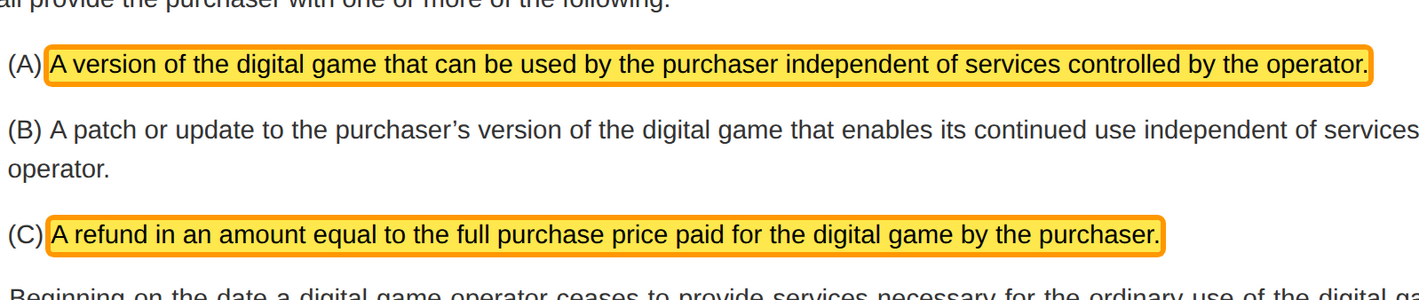 a playable version or a refund once services cease
 -
 games sold or rereleased on or after January 1, 2027
 -
 hosting and cloud providers are not operators
 -
 subscription, free-to-play, and DRM-free downloads are exempt
 -
 a version that runs without the operator's servers
 -
 the digest pointing to existing buy and purchase labeling law
 -
 the refund remedy copies and alters nothing
References
[edit | edit source]- ↑ 1.0 1.1 Callaham, John (2023-12-14). "Ubisoft delists the first game in The Crew racing series; servers will shut down March 31". Neowin. Archived from the original on 2023-12-14. Retrieved 2026-06-10.
- ↑ 2.0 2.1 2.2 Bonifacic, Igor (2024-04-01). "Ubisoft is deleting The Crew from players' libraries, reminding us we own nothing". Engadget. Archived from the original on 2024-04-14. Retrieved 2026-06-10.
- ↑ 3.00 3.01 3.02 3.03 3.04 3.05 3.06 3.07 3.08 3.09 3.10 Pierre-Louis, Stanley (2026). "Opinion: Misguided California bill would harm video game makers, players". Sacramento Bee. Entertainment Software Association. Archived from the original on 2026-06-10. Retrieved 2026-06-10.
- ↑ 4.0 4.1 4.2 4.3 4.4 4.5 4.6 "AB 1921, Protect Our Games Act". California Legislative Information. California State Legislature. Archived from the original on 2026-06-12. Retrieved 2026-06-10.
- ↑ 5.0 5.1 5.2 "AB 1921 (Ward) Assembly Committee on Privacy and Consumer Protection Analysis" (PDF). California State Assembly. Assembly Committee on Privacy and Consumer Protection. April 2026. Archived from the original (PDF) on 2026-06-12. Retrieved 2026-06-10.
- ↑ "Stop Killing Games". Stop Killing Games. Archived from the original on 2026-06-10. Retrieved 2026-06-10.
- ↑ 7.0 7.1 7.2 "Stop Destroying Videogames". European Citizens' Initiative. European Commission. Archived from the original on 2026-01-31. Retrieved 2026-06-10.
- ↑ "Scale fleet capacity to and from zero". Amazon GameLift Servers Developer Guide. Amazon Web Services. Archived from the original on 2026-03-08. Retrieved 2026-06-10.
- ↑ Osborn, George (2025-10-08). "Stop Killing Games will become an early test of how games respond to consumer power". Mode Collapse. Archived from the original on 2025-10-09. Retrieved 2026-06-10.
- ↑ "Knockout City Private Server Edition". Knockout City. Velan Studios. Archived from the original on 2023-05-05. Retrieved 2026-06-10.
- ↑ Olney, Liam (February 2024). "Gran Turismo Sport's Last Ever PS4 Patch Enables Offline Saves". Push Square. Archived from the original on 2024-02-01. Retrieved 2026-06-10.
- ↑ "Capcom Is Releasing An Offline Version Of Mega Man X DiVE". Nintendo Life. August 2023. Archived from the original on 2023-08-19. Retrieved 2026-06-10.
- ↑ 13.0 13.1 "2026 Essential Facts About the U.S. Video Game Industry" (PDF). Entertainment Software Association. Entertainment Software Association. April 2026. Archived from the original (PDF) on 2026-05-10. Retrieved 2026-06-10.
- ↑ Carter, Justin (2022-09-13). "Square Enix will shut down Babylon's Fall in 2023". Game Developer. Archived from the original on 2022-09-13. Retrieved 2026-06-10.
- ↑ "Anthem Game Update". Electronic Arts. Electronic Arts. Archived from the original on 2026-01-14. Retrieved 2026-06-10.
- ↑ "AB 2426, Civil law: false advertising: digital goods". California Legislative Information. California State Legislature. Archived from the original on 2026-06-12. Retrieved 2026-06-10.
- ↑ "California Business and Professions Code Section 17536". California Legislative Information. California State Legislature. Archived from the original on 2026-06-12. Retrieved 2026-06-10.
- ↑ "SB 244, Right to Repair Act". California Legislative Information. California State Legislature. Archived from the original on 2026-06-12. Retrieved 2026-06-10.
- ↑ "Directive (EU) 2024/1799 on common rules promoting the repair of goods". EUR-Lex. European Union. 2024-06-13. Archived from the original on 2024-07-10. Retrieved 2026-06-10.
- ↑ "15 U.S.C. 2301, Magnuson-Moss Warranty Act, definitions". Legal Information Institute. Cornell Law School. Archived from the original on 2026-02-24. Retrieved 2026-06-10.
- ↑ "California Civil Code Section 1770, Consumers Legal Remedies Act". California Legislative Information. California State Legislature. Archived from the original on 2026-06-12. Retrieved 2026-06-10.
- ↑ "15 U.S.C. 45, Unfair methods of competition unlawful". Legal Information Institute. Cornell Law School. Archived from the original on 2026-05-15. Retrieved 2026-06-10.
- ↑ Sawers, Paul (2016-04-04). "Alphabet's Nest will permanently turn off all Revolv hubs on May 15, 2016". VentureBeat. Archived from the original on 2022-12-07. Retrieved 2026-06-10.
- ↑ "As Nest kills Revolv, can we trust 'lifetime guarantees' and IoT?". Cult of Android. 2016-04-25. Archived from the original on 2016-04-29. Retrieved 2026-06-10.
- ↑ Bode, Karl (2020-03-13). "Sonos Backs Off Plan To Brick Older, Still-Functioning Speakers". Techdirt. Archived from the original on 2022-07-06. Retrieved 2026-06-10.
- ↑ Carlson, Jenny (2022-04-25). "Insteon Abruptly Shuts Down, Users Left Smart-Home-Less". Hackaday. Archived from the original on 2022-04-25. Retrieved 2026-06-10.
- ↑ Forristal, Lauren (2024-12-09). "Spotify has disabled Car Thing streaming devices". TechCrunch. Archived from the original on 2024-12-09. Retrieved 2026-06-10.
- ↑ Perez, Sarah (2024-05-30). "Spotify begins offering Car Thing refunds as it faces lawsuit over bricking the streaming device". TechCrunch. Archived from the original on 2024-05-30. Retrieved 2026-06-10.
- ↑ Squires-Hand, Liam (2026-01-30). "Stop Destroying Videogames initiative to get a public hearing organised by the European Parliament". GamingOnLinux. Archived from the original on 2026-01-30. Retrieved 2026-06-10.
- ↑ Reiner, Andrew (2018-10-25). "Alan Wake Returns To PC After Microsoft Renegotiates Music Licenses". Game Informer. Archived from the original on 2019-07-11. Retrieved 2026-06-10.
- ↑ Geigner, Timothy (2024-09-13). "Thanks Complicated Music Licensing Schemes: Alan Wake Updated To Remove Bowie Song From Credits". Techdirt. Archived from the original on 2024-09-15. Retrieved 2026-06-10.
- ↑ "Forza Horizon 4 Delisting". Forza. Turn 10 Studios. 2024. Archived from the original on 2026-06-12. Retrieved 2026-06-10.
- ↑ "17 U.S.C. 301, Preemption with respect to other laws". Legal Information Institute. Cornell Law School. Archived from the original on 2026-05-01. Retrieved 2026-06-10.
- ↑ ProCD, Inc. v. Zeidenberg, 86 F.3d 1447 (7th Cir. 1996). "ProCD, Inc. v. Zeidenberg, 86 F.3d 1447". Justia. Archived from the original on 2026-01-15. Retrieved 2026-06-10.
- ↑ Vault Corp. v. Quaid Software Ltd., 847 F.2d 255 (5th Cir. 1988). "Vault Corp. v. Quaid Software Ltd., 847 F.2d 255". Justia. Archived from the original on 2025-03-06. Retrieved 2026-06-10.
- ↑ "17 U.S.C. 1201, Circumvention of copyright protection systems". Legal Information Institute. Cornell Law School. Archived from the original on 2026-05-01. Retrieved 2026-06-10.
- ↑ "Exemption to Prohibition on Circumvention of Copyright Protection Systems for Access Controls". Federal Register. Library of Congress, Copyright Office. 2024-10-28. Archived from the original on 2024-11-02. Retrieved 2026-06-10.
- ↑ "Section 1201 Rulemaking: Ninth Triennial Proceeding, Register's Recommendation, at 191 (Proposed Class 6(b), the video game class)" (PDF). U.S. Copyright Office. October 2024. Archived from the original (PDF) on 2024-10-26. Retrieved 2026-06-11.
- ↑ "ESA Says No to Remote Access for Game Research". Video Game History Foundation. Video Game History Foundation. 2024. Archived from the original on 2024-10-25. Retrieved 2026-06-10.
- ↑ "Section 1201 Rulemaking: Ninth Triennial Proceeding, Register's Recommendation, at 190 (Proposed Class 6(b), the video game class)" (PDF). U.S. Copyright Office. October 2024. Archived from the original (PDF) on 2024-10-26. Retrieved 2026-06-12.
- ↑ Lang, Ben (2023). "John Carmack Issues Statement on Echo VR Closure". UploadVR. Archived from the original on 2023-02-04. Retrieved 2026-06-10.